We would like to thank Dr. Claude Keisch, Berlin, for confirming the authenticity of the watercolour.
Exhibition
Ausstellung von Werken Adolph von Menzels. Berlin, Königliche Nationalgalerie, 1905, cat. no. 325 / Hundert Jahre Berliner Kunst. Berlin, Verein der Berliner Künstler, 1929, cat. no. 1002 („Gruft in der Garnisonkirche, Berlin“) / Adolph von Menzel 1815–1905. Ölgemälde, Gouachen, Pastelle, Aquarelle und Zeichnungen. München, Galerie Caspari, 1932,cat. no. 20 („Gruft des Generalfeldmarschalls Keith in der Potsdamer Garnisonkirche“) / Deutsche Zeichenkunst aus zwei Jahrhunderten. 1760 bis 1960. Aquarelle, Zeichnungen und Druckgraphik aus der Sammlung W.B. Karlsruhe, Staatliche Kunsthalle, 1967, cat. no. 85
Literature and illustration
Auktion: Ölgemälde, Pastelle und Aquarelle erster Meister unserer Zeit. Berlin, Rudolph Lepke’s Kunst-Auctions-Haus, 30.10.1900, Kat.-Nr. 38 / Exh. cat. AdoIph Menzel. Zeichnungen. Berlin (Ost), National-Galerie, 1955, mentioned on p. 127 with the no. 257 (drawing with the same motif) / 29. Auktion: Sammlung Heumann, Chemnitz. Kunst des 18. und 19. Jahrhunderts. Stuttgart, Stuttgarter Kunstkabinett, 29.11.1957, cat. no. 201, ill. pl. 32 / Claude Keisch: Menzel, die Toten, der Tod. In: Adolph Menzel im Labyrinth der Wahrnehmung. Kolloquium, Supplement to the yearbook of Berlin Museums, vol. 41, 1999, p. 31-50, here p. 43, ill
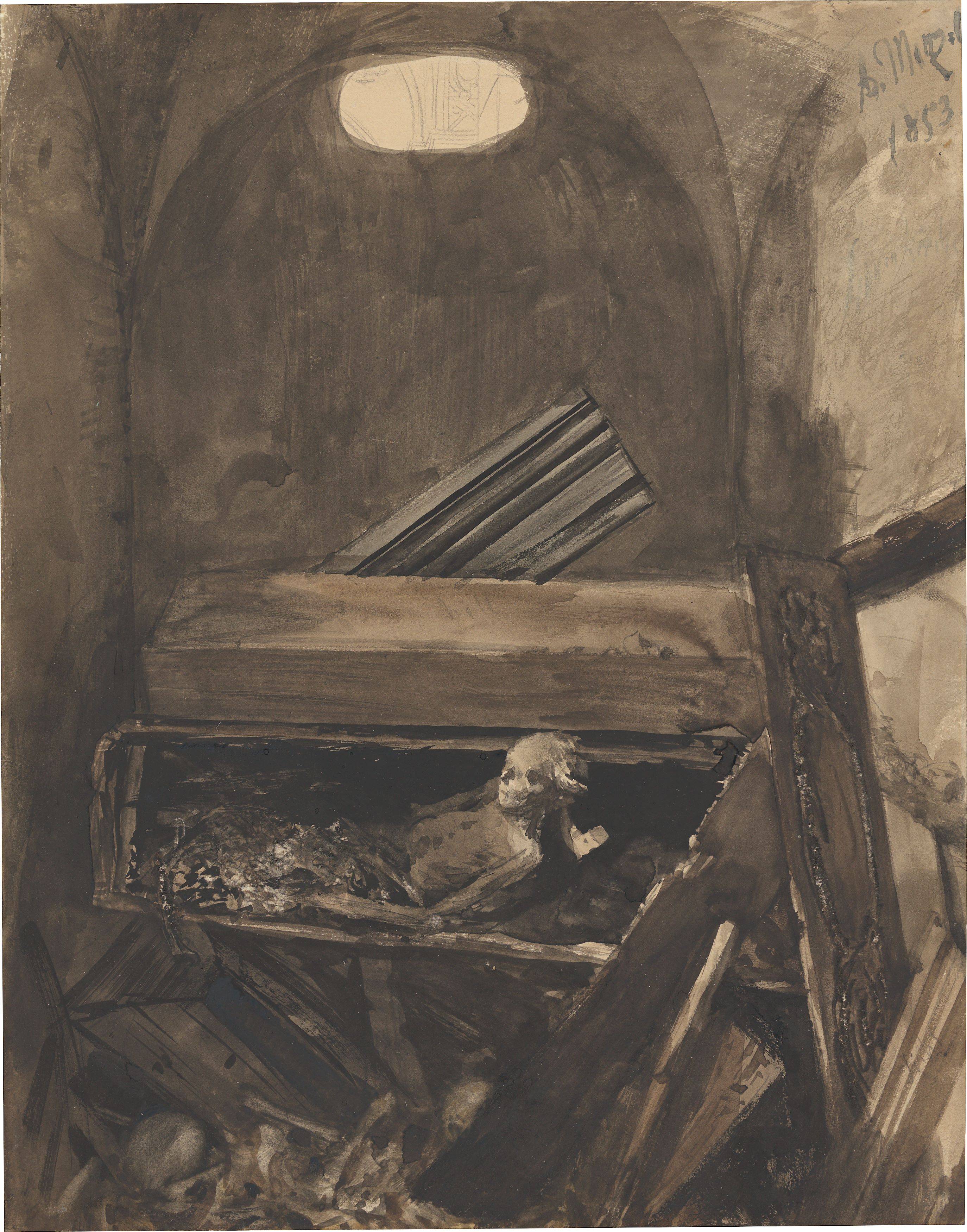
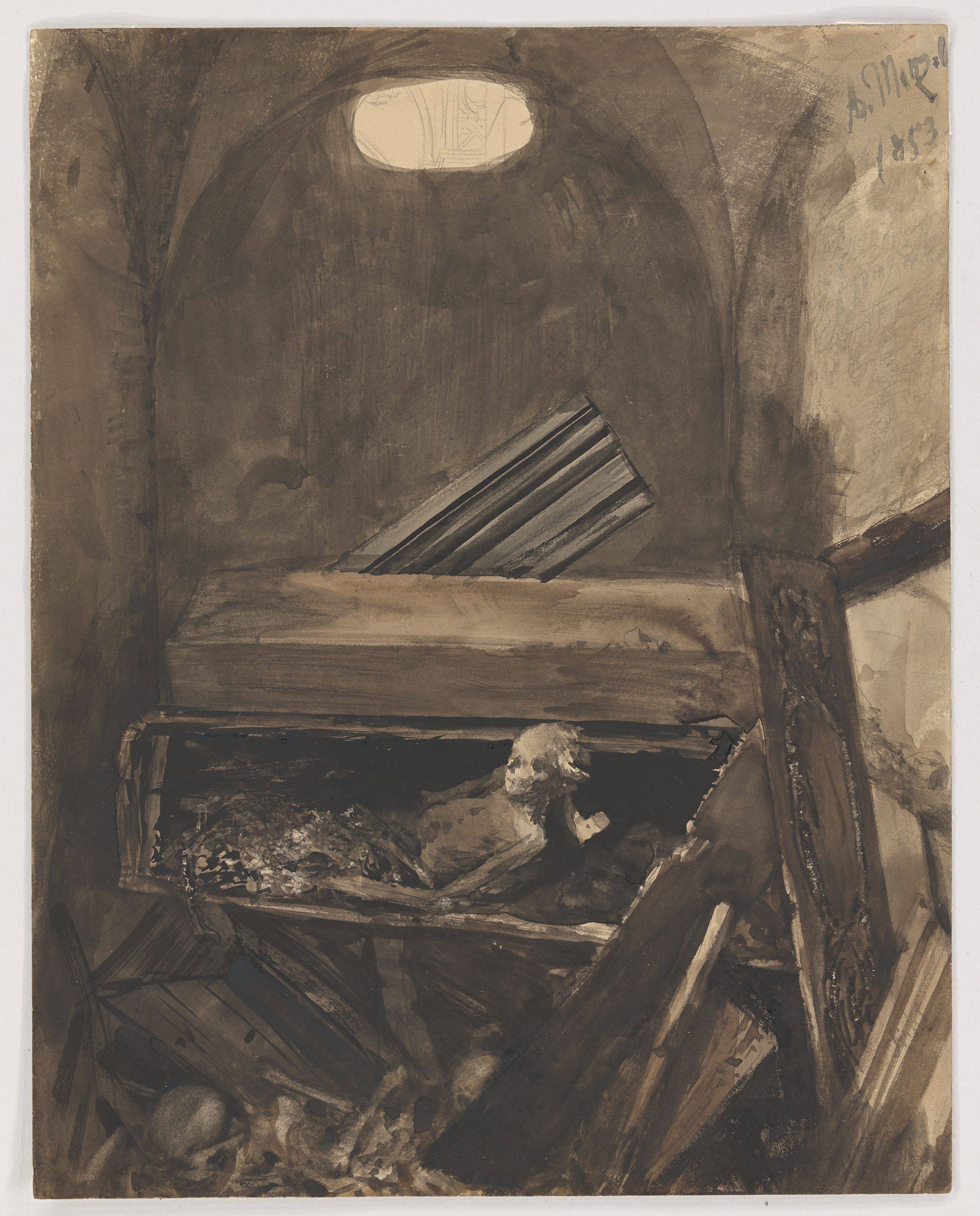
It is a simultaneity of the incompatible. Does the gaze fall diagonally downward, as suggested by the bird's-eye view of the open coffin (for if it were tilted, its contents would also have to obey gravity), or upward toward the blinding light of an opening that one would not expect so close to the vaulted ceiling? Judging by the reflections on the corpse, its oval shape should actually be interpreted as a circle in perspective foreshortening, and the obviously flat wall as a half-dome. Behind it, faint but unmistakable, is a view of the interior of a church.
Against all odds, the eye of light had to be placed right here, separated by an extensive neutral zone from the small-scale tangle around the coffin, on which its light falls with the restlessness of a torch: It ‘lifts’ the gaunt mummy, and especially her face, out of the light-dark, dramatic criss-cross of beams and boards of the baroque-decorated coffin lid and the scattered bones. The view into the lower deck of a storm-tossed ship could not be more frightening.
Decaying for decades and temporarily abandoned as a place of worship, the Romanesque Liebfrauenkirche had been restored under the supervision of chief conservator Ferdinand von Quast, but even after its resurrection at Pentecost in 1848, construction work must have continued: During a brief visit to the city in 1852, Menzel stood before the chaos of a temporarily open crypt, which, as he noted, was ‘later bricked up’. His large, meticulous drawing of the coffin with the corpse in the Berlin Kupferstichkabinett from 1852 was transferred in detail to a grisaille watercolour a year later: a technique whose ghostly shadow contrasts are reminiscent of his ‘Versuche auf Stein mit Pinsel und Schabeisen’ (Experiments on Stone with Brush and Scraper, 1851).
With meticulous detail and a fixed gaze, so to speak, following the close-up view of the coffin, he was able to reconstruct (or construct) and dramatise the confusing spatial context from memory: it now seems as if the dead man himself, by sitting up, has blown up the structures surrounding him. This is how the Middle Ages painted the resurrection of the dead on Judgement Day.
At least twice more, in 1857 and 1873, Menzel was to stand drawing in front of open coffins. The grisaille, however, once belonged to the painter Franz Skarbina, who probably already had it in mind in 1878 when he painted the large picture ‘Awakening of a Dead Man in the Anatomy’ (in the German Historical Museum). Compared to his straightforward naturalism, Menzel's Reconciliation proves to be a work of eerie pathos and sobriety, halfway between ‘Failed Hope’ and ‘The Fall of the House of Usher,’ an unexpected response to international Romanticism. Claude Keisch
Subject to change - Please refer to our conditions of sale.