We would like to thank Dr. Claude Keisch, Berlin, for confirming the authenticity of the pastel.
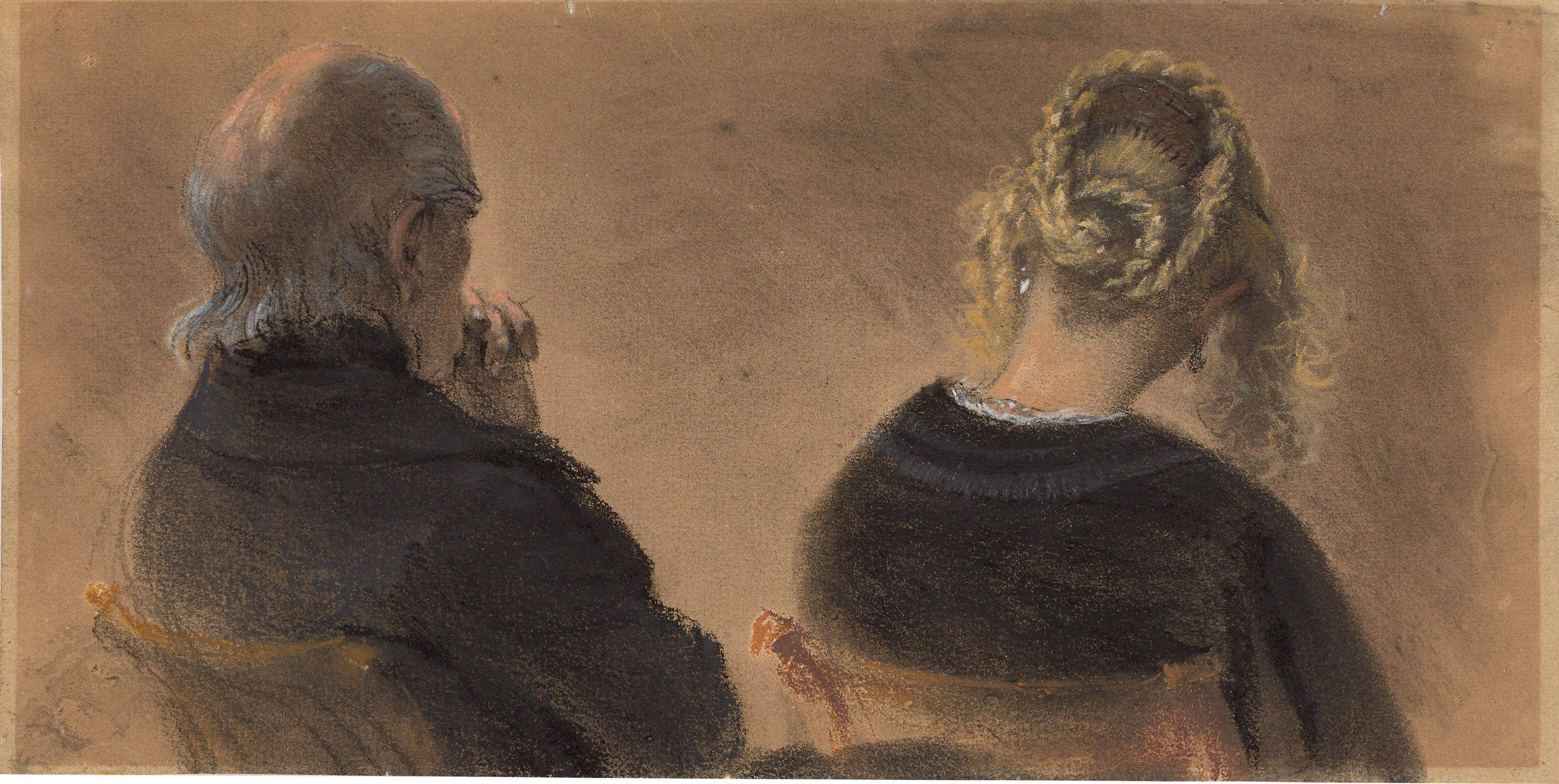
Menzel ‘was prone to observing observers,’ explained Françoise Forster-Hahn in an essay on the legendary ‘Balcony Room’ from the collection of the Berlin National Gallery. And it's true: probably no other German artist of the 19th century made seeing the subject of his works as much as Adolph Menzel. Time and again, he drew and painted the moment of viewing – from the exaggerated gawking at zoo animals to tired glances from the railway compartment to reverent contemplation in the museum. The most meticulous observer was Menzel himself: ‘No Kodak reflected more sharply’ than his unerring eyes, wrote Axel Delmar in 1905 in his obituary for ‘the little excellence’. Menzel's observations always developed their greatest power where his gaze could examine unnoticed, for example during a theatre performance or concert. The pastel from the Bauer Collection can also be classified in this context. With great ease, masterful speed and yet precision, Menzel applies the pastel strokes to the brownish paper. He is particularly interested in the elaborate braided hairstyle of the lady seated to the right of an elderly gentleman. The fascination was so great that Menzel captured the same woman's head in a second pastel, which formerly belonged to Max Liebermann (Christie's London auction, 4 July 2023, lot 96). In both cases, he places all the heads in a lost profile. The faces disappear almost completely, and the classic repoussoir figure, which draws the viewer's gaze to an object in the distance, is referenced and at the same time reduced to absurdity, because the space is not rendered. Everything revolves around the experience of meaning: above all around seeing, but also – typical of Menzel! – around feeling and hearing. The man's right ear receives some attention, as do the white pearls on the lady's ears. Perhaps, or even probably, they are listening to music. The man has brought his sensitive hand to his mouth in a gesture of self-forgetful contemplation. Thus, Walter Bauer's small pastel painting contains a grand idea that shaped Menzel's art from his youth to his old age: the idea of a multisensory experience of the world in general and the sensations of the eye and ear in particular – the two senses that, for the artist and music lover Menzel, stand above all others because they make sounds audible and images visible. FMG
We would like to thank Dr. Claude Keisch, Berlin, for confirming the authenticity of the pastel.
Menzel ‘was prone to observing observers,’ explained Françoise Forster-Hahn in an essay on the legendary ‘Balcony Room’ from the collection of the Berlin National Gallery. And it's true: probably no other German artist of the 19th century made seeing the subject of his works as much as Adolph Menzel. Time and again, he drew and painted the moment of viewing – from the exaggerated gawking at zoo animals to tired glances from the railway compartment to reverent contemplation in the museum. The most meticulous observer was Menzel himself: ‘No Kodak reflected more sharply’ than his unerring eyes, wrote Axel Delmar in 1905 in his obituary for ‘the little excellence’. Menzel's observations always developed their greatest power where his gaze could examine unnoticed, for example during a theatre performance or concert. The pastel from the Bauer Collection can also be classified in this context. With great ease, masterful speed and yet precision, Menzel applies the pastel strokes to the brownish paper. He is particularly interested in the elaborate braided hairstyle of the lady seated to the right of an elderly gentleman. The fascination was so great that Menzel captured the same woman's head in a second pastel, which formerly belonged to Max Liebermann (Christie's London auction, 4 July 2023, lot 96). In both cases, he places all the heads in a lost profile. The faces disappear almost completely, and the classic repoussoir figure, which draws the viewer's gaze to an object in the distance, is referenced and at the same time reduced to absurdity, because the space is not rendered. Everything revolves around the experience of meaning: above all around seeing, but also – typical of Menzel! – around feeling and hearing. The man's right ear receives some attention, as do the white pearls on the lady's ears. Perhaps, or even probably, they are listening to music. The man has brought his sensitive hand to his mouth in a gesture of self-forgetful contemplation. Thus, Walter Bauer's small pastel painting contains a grand idea that shaped Menzel's art from his youth to his old age: the idea of a multisensory experience of the world in general and the sensations of the eye and ear in particular – the two senses that, for the artist and music lover Menzel, stand above all others because they make sounds audible and images visible. FMG