We would like to thank Prof. Michael Thimann, Göttingen, for kindly confirming the authenticity of the drawing.
Literature and illustration
Auktion 98: Handzeichnungen alter Meister. Bestände aus den Sammlungen des Fürsten von Liechtenstein. Beiträge aus Schweizerischen und überseeischen Privatsammlungen. Bern, Klipstein und Kornfeld, 16.6.1960, cat. no. 186, ill. pl. 65 (as work by Ferdinand Olivier) / C. G. Boerner (ed.): Dreißig graphische Meisterwerke. Lagerliste 30. Dusseldorf, C. G. Boerner, 1960, cat. no. 26, w. ill.
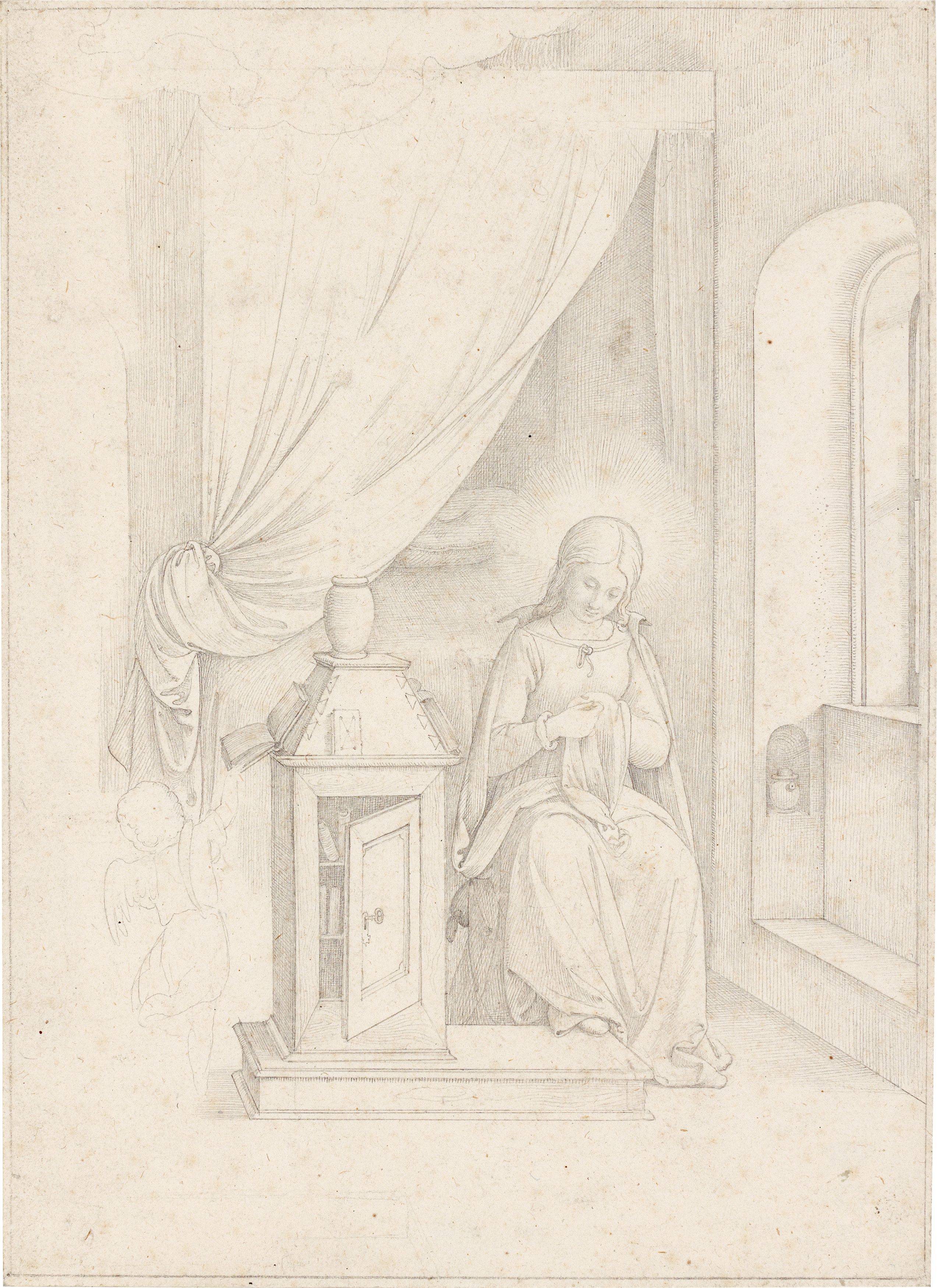
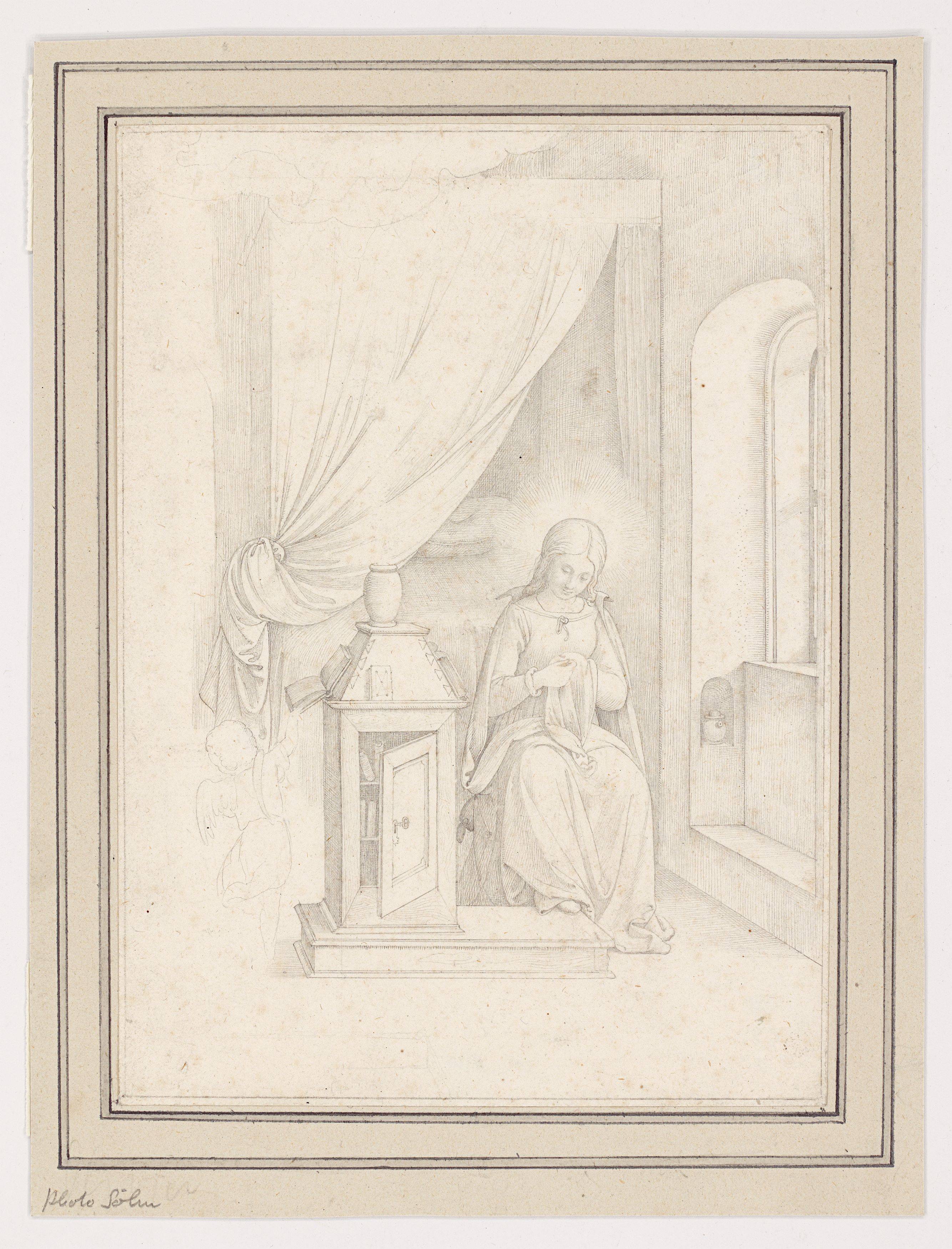
This high-quality small sheet is a true marvel of Nazarene drawing and, at the same time, a first-rate puzzle picture. It entered the Bauer Collection under the attribution to Ferdinand Olivier. This will be discussed below. First, however, the old interpretation of the picture's theme as ‘The Virtuous Woman’ (Proverbs 31:10 ff.) must be corrected. Friedrich Overbeck had made a drawing of this motif in 1813, which Ferdinand Ruscheweyh did not transfer to copperplate until 1835. In this print, the virtuous woman can be seen working at her spinning wheel at night, while her husband sleeps peacefully in bed with their small child: ‘A virtuous woman is far more precious than the most exquisite pearls.’ Overbeck expressed the allegorical character of the proverb visually by showing the beneficial achievements of the virtuous night worker in an emblematic, coded manner on the left half of the picture. However, we do not see an allegory in this drawing. The halo, the prayer desk with the prayer books and the presence of a small angel suggest that this is a depiction of the Virgin Mary before the Annunciation. The erased lilies in the vase on the prayer desk also point to Mary. The alcove is also empty, indicating her virginity. In a long iconographic tradition, Mary was often depicted in her room engaged in needlework. The iconography of the virtuous woman also requires a distaff and spinning wheel, because this work is central to the biblical text. In comparison with Ruscheweyh's engraving after Overbeck, which was probably decisive in the old attribution of our print, the differences can be clearly identified. The comparison does not work iconographically, but it is useful in terms of attributing the work to Friedrich Overbeck. The window niche depicted is identical in both representations, except that in the virtuous woman it is closed and lit by an oil lamp. It is night; the woman is working while the others sleep. In the present drawing, however, it is daytime and the sun is shining in. If Overbeck is the creator of the drawing, as suggested by its high quality and skilful line work, he has given us a remarkably genre-like representation of the Marian theme, which was even intended to have a humorous punchline in the form of an angel foolishly playing with the prayer book, which remained unfinished. It would be difficult to find a comparable drawing in Ferdinand Olivier's oeuvre; one might be more likely to find one among the works of his brother Friedrich Olivier, who created similarly detailed historical drawings for his ‘picture Bible’. Ultimately, however, his lines are softer, and he lacks the Dürer-like mastery in the reproduction of the material world that Overbeck demonstrates in this interior. This raises further questions that will have to be addressed in future studies of the drawing. For example: How does this drawing relate to the idea of ideal brides as depicted by Overbeck's friend Franz Pforr in his 1811 diptych ‘Sulamith and Mary’? Michael Thimann
We would like to thank Prof. Michael Thimann, Göttingen, for kindly confirming the authenticity of the drawing.
Literature and illustration
Auktion 98: Handzeichnungen alter Meister. Bestände aus den Sammlungen des Fürsten von Liechtenstein. Beiträge aus Schweizerischen und überseeischen Privatsammlungen. Bern, Klipstein und Kornfeld, 16.6.1960, cat. no. 186, ill. pl. 65 (as work by Ferdinand Olivier) / C. G. Boerner (ed.): Dreißig graphische Meisterwerke. Lagerliste 30. Dusseldorf, C. G. Boerner, 1960, cat. no. 26, w. ill.
This high-quality small sheet is a true marvel of Nazarene drawing and, at the same time, a first-rate puzzle picture. It entered the Bauer Collection under the attribution to Ferdinand Olivier. This will be discussed below. First, however, the old interpretation of the picture's theme as ‘The Virtuous Woman’ (Proverbs 31:10 ff.) must be corrected. Friedrich Overbeck had made a drawing of this motif in 1813, which Ferdinand Ruscheweyh did not transfer to copperplate until 1835. In this print, the virtuous woman can be seen working at her spinning wheel at night, while her husband sleeps peacefully in bed with their small child: ‘A virtuous woman is far more precious than the most exquisite pearls.’ Overbeck expressed the allegorical character of the proverb visually by showing the beneficial achievements of the virtuous night worker in an emblematic, coded manner on the left half of the picture. However, we do not see an allegory in this drawing. The halo, the prayer desk with the prayer books and the presence of a small angel suggest that this is a depiction of the Virgin Mary before the Annunciation. The erased lilies in the vase on the prayer desk also point to Mary. The alcove is also empty, indicating her virginity. In a long iconographic tradition, Mary was often depicted in her room engaged in needlework. The iconography of the virtuous woman also requires a distaff and spinning wheel, because this work is central to the biblical text. In comparison with Ruscheweyh's engraving after Overbeck, which was probably decisive in the old attribution of our print, the differences can be clearly identified. The comparison does not work iconographically, but it is useful in terms of attributing the work to Friedrich Overbeck. The window niche depicted is identical in both representations, except that in the virtuous woman it is closed and lit by an oil lamp. It is night; the woman is working while the others sleep. In the present drawing, however, it is daytime and the sun is shining in. If Overbeck is the creator of the drawing, as suggested by its high quality and skilful line work, he has given us a remarkably genre-like representation of the Marian theme, which was even intended to have a humorous punchline in the form of an angel foolishly playing with the prayer book, which remained unfinished. It would be difficult to find a comparable drawing in Ferdinand Olivier's oeuvre; one might be more likely to find one among the works of his brother Friedrich Olivier, who created similarly detailed historical drawings for his ‘picture Bible’. Ultimately, however, his lines are softer, and he lacks the Dürer-like mastery in the reproduction of the material world that Overbeck demonstrates in this interior. This raises further questions that will have to be addressed in future studies of the drawing. For example: How does this drawing relate to the idea of ideal brides as depicted by Overbeck's friend Franz Pforr in his 1811 diptych ‘Sulamith and Mary’? Michael Thimann