Deutsche Zeichenkunst aus zwei Jahrhunderten. 1760 bis 1960. Aquarelle, Zeichnungen und Druckgraphik aus der Sammlung W.B. Karlsruhe, Staatliche Kunsthalle, 1967, cat. no. 123
Literature and illustration
Auction 92: Kunst 19./20. Jahrhundert. Graphik, Zeichnungen, Aquarelle und Ölgemälde. Karl & Faber, München, 1964, cat. no. 887, ill.
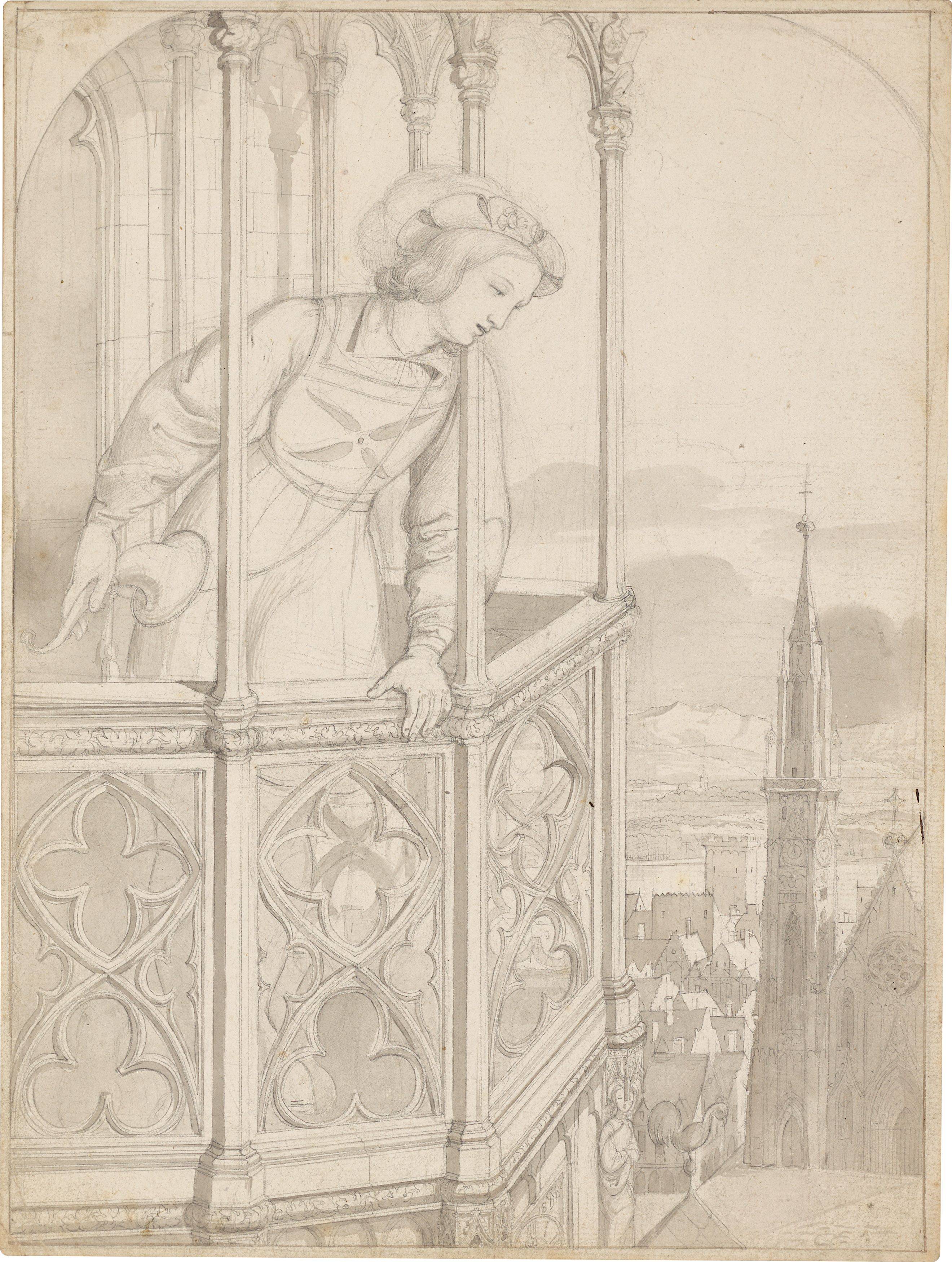
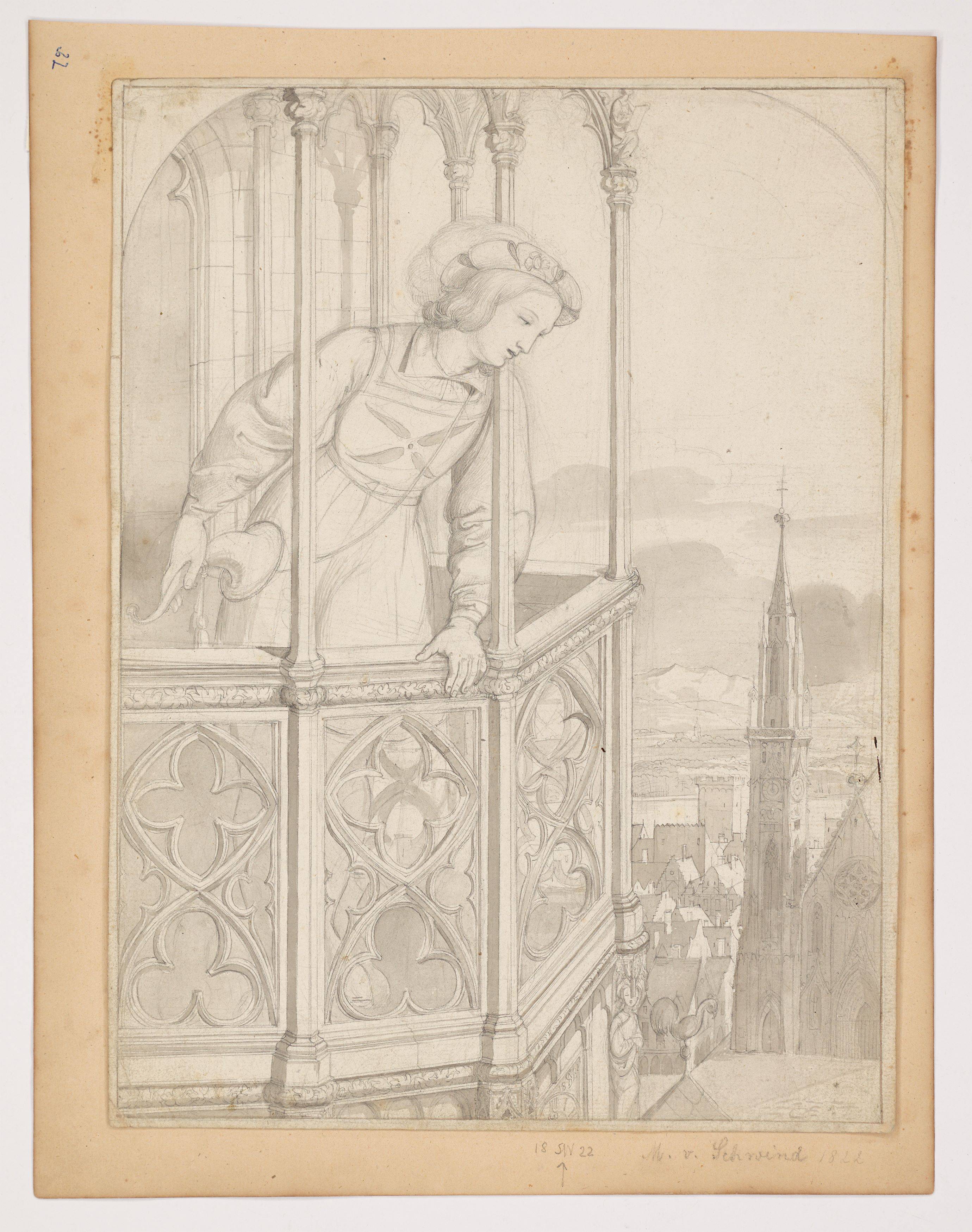
This is one of Moritz von Schwind's earliest drawings, created in 1822 while he was studying at the Vienna Academy. During this period, the highly talented artist became friends with Franz Schubert, Franz Grillparzer, the Olivier brothers and other Romantics. The sheet is thoroughly Romantic and fits into a group of early drawings by Schwind that depict scenes from the Middle Ages, knightly life and legends. With its thoroughly poetic character, it can be placed alongside the important early works ‘Liebespaar im Nachen’ (Lovers in a Boat, 1823, Hamburger Kunsthalle) and the even more famous ‘Erscheinung im Walde’ (Apparition in the Forest, 1823, Washington, National Gallery). These sheets are lyrical, even if it remains difficult to identify the underlying poem. This is also the case with our sheet, which would probably be better titled ‘The Tower Guard’. For that is what is depicted here: a young man in Renaissance costume, holding a signal horn, has taken up his post on the highest tower in the city to protect its population from fire or the threat of a foreign army. The profession of watchman was an important office, even if its social status was not particularly high. Schwind gives this medieval figure a poetic twist: his tower keeper gazes dreamily and poetically over the medieval city, which could be Vienna with St. Stephen's Cathedral. The watchman's gaze reaches into the far distance, across the plain to the foothills of the mountains. This suggests that Schwind's invention was based on a poem by Goethe, namely the ‘Song of the Watchman’ from the second part of “Faust”: "Born to see, / Destined to watch, / Sworn to the tower, I like the world. // I gaze into the distance, I see nearby / The moon and the stars, The forest and the deer. (...)". Schwinds drawing, with its delicate execution and delicate wash, is a consummate work of art and predates Eduard von Steinles painting ‘Der Türmer’ (The Tower Keeper) from 1859 in the Schack Collection, which is generally considered the most significant Romantic interpretation of this theme. Schwind, in a manner previously unknown to art history, perfectly anticipated it. Michael Thimann
Deutsche Zeichenkunst aus zwei Jahrhunderten. 1760 bis 1960. Aquarelle, Zeichnungen und Druckgraphik aus der Sammlung W.B. Karlsruhe, Staatliche Kunsthalle, 1967, cat. no. 123
Literature and illustration
Auction 92: Kunst 19./20. Jahrhundert. Graphik, Zeichnungen, Aquarelle und Ölgemälde. Karl & Faber, München, 1964, cat. no. 887, ill.
This is one of Moritz von Schwind's earliest drawings, created in 1822 while he was studying at the Vienna Academy. During this period, the highly talented artist became friends with Franz Schubert, Franz Grillparzer, the Olivier brothers and other Romantics. The sheet is thoroughly Romantic and fits into a group of early drawings by Schwind that depict scenes from the Middle Ages, knightly life and legends. With its thoroughly poetic character, it can be placed alongside the important early works ‘Liebespaar im Nachen’ (Lovers in a Boat, 1823, Hamburger Kunsthalle) and the even more famous ‘Erscheinung im Walde’ (Apparition in the Forest, 1823, Washington, National Gallery). These sheets are lyrical, even if it remains difficult to identify the underlying poem. This is also the case with our sheet, which would probably be better titled ‘The Tower Guard’. For that is what is depicted here: a young man in Renaissance costume, holding a signal horn, has taken up his post on the highest tower in the city to protect its population from fire or the threat of a foreign army. The profession of watchman was an important office, even if its social status was not particularly high. Schwind gives this medieval figure a poetic twist: his tower keeper gazes dreamily and poetically over the medieval city, which could be Vienna with St. Stephen's Cathedral. The watchman's gaze reaches into the far distance, across the plain to the foothills of the mountains. This suggests that Schwind's invention was based on a poem by Goethe, namely the ‘Song of the Watchman’ from the second part of “Faust”: "Born to see, / Destined to watch, / Sworn to the tower, I like the world. // I gaze into the distance, I see nearby / The moon and the stars, The forest and the deer. (...)". Schwinds drawing, with its delicate execution and delicate wash, is a consummate work of art and predates Eduard von Steinles painting ‘Der Türmer’ (The Tower Keeper) from 1859 in the Schack Collection, which is generally considered the most significant Romantic interpretation of this theme. Schwind, in a manner previously unknown to art history, perfectly anticipated it. Michael Thimann