
Skip to content
Go to Grisebach homepage

Online Catalogue

All lots

Modern & 19th Century Art

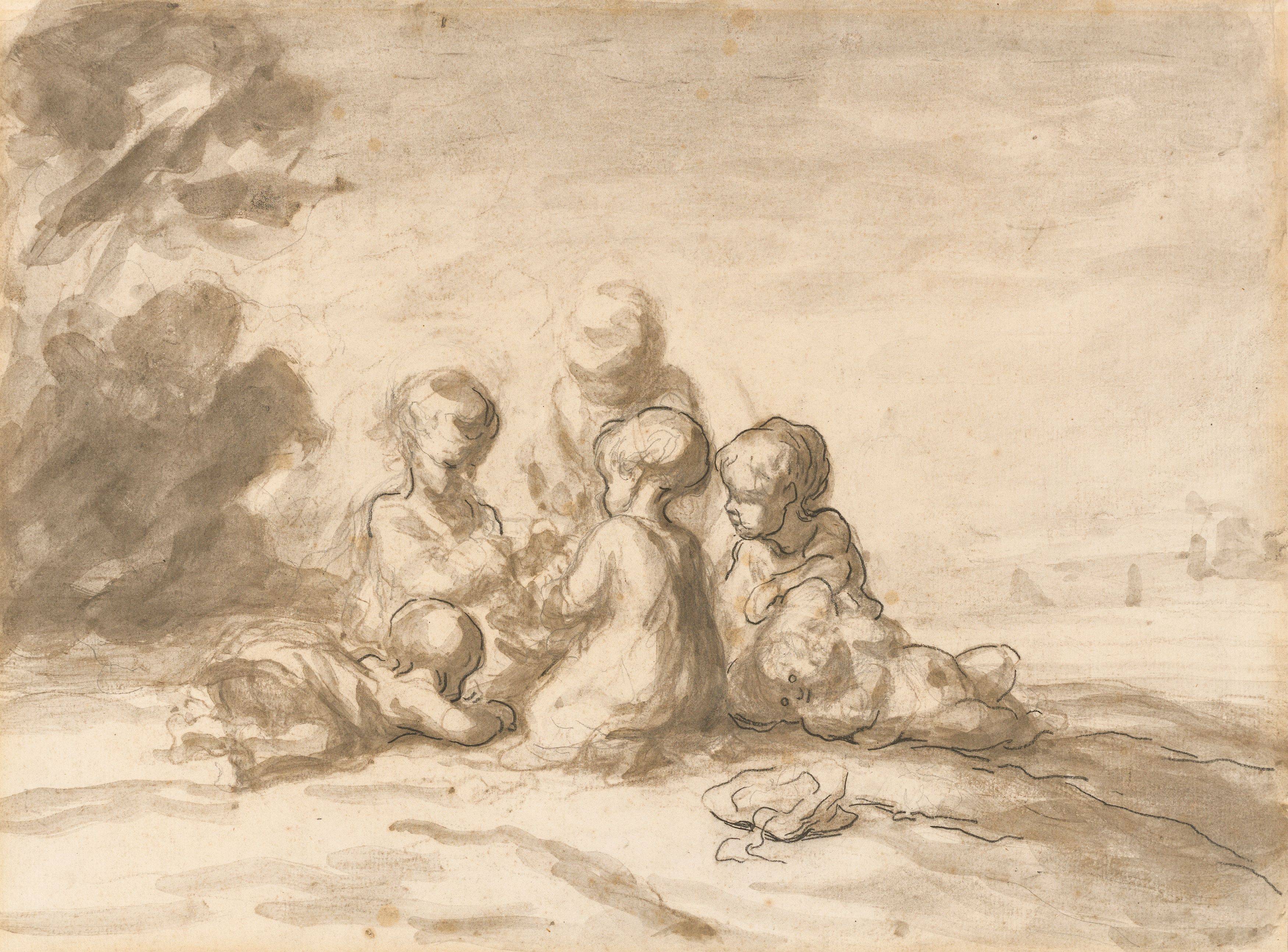
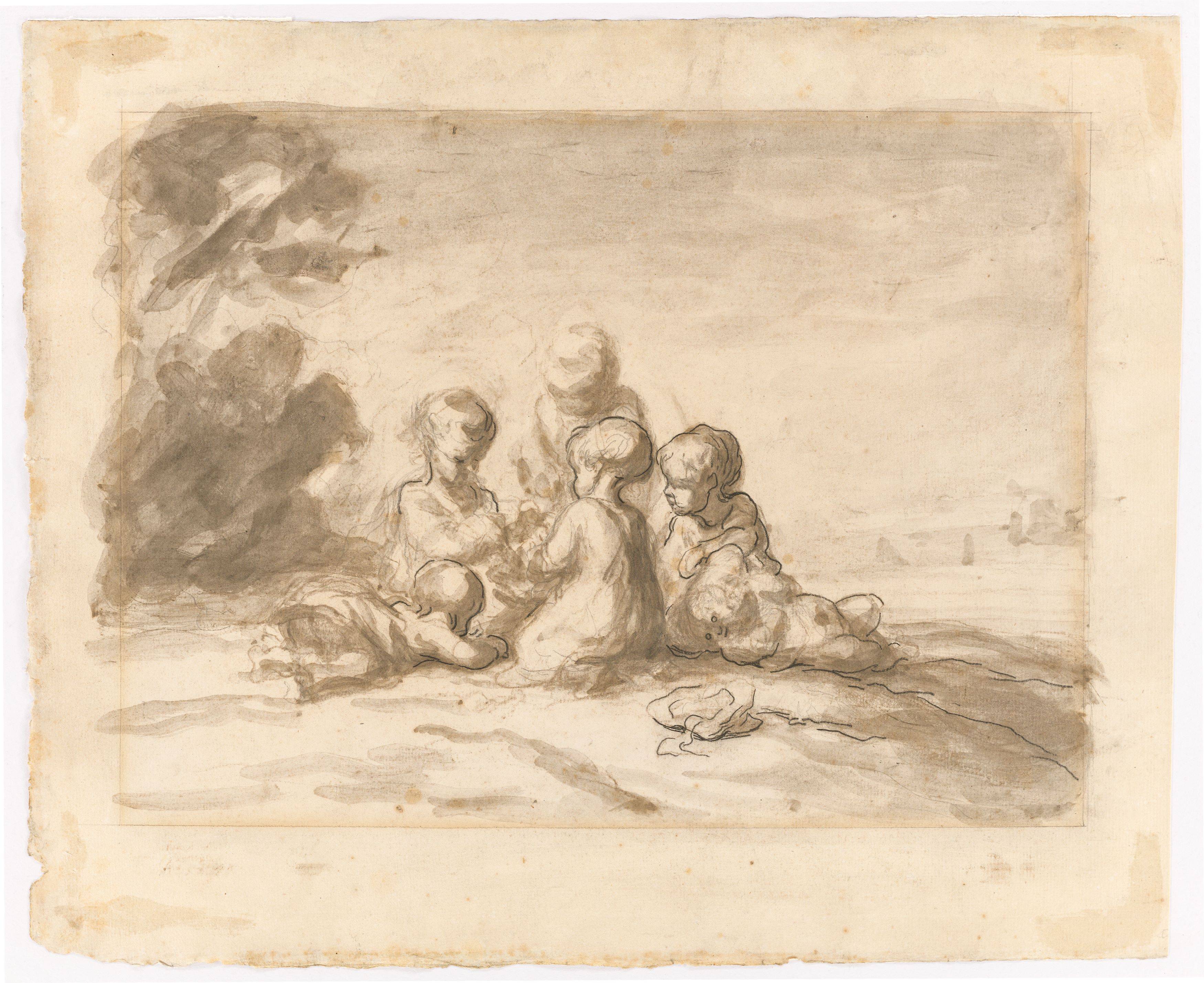
This picture shows the following artwork: Honoré Daumier. ”Enfants jouant sous des arbres”.
303 Honoré Daumier

Marseille 1808 – 1879 Valmondois

”Enfants jouant sous des arbres”.

Tempera, chalk and pencil on buff-coloured laid paper (watermark: HUDELIST). 36,5 × 44,7 cm (14 ⅜ × 17 ⅝ in.). Catalogue raisonné: Noack 10252. [3145] Framed

Provenance

Mme Emmer, Paris (1923 or 1927) / Louis Lemaire, Paris (circa 1968) / Eugene V. Thaw, New York / Private Collection, Bavaria

EUR 10,000


- 15,000

USD 11,800


- 17,600

Sold for:

13,970 EUR (incl. premium)

Auction 372

Friday, November 28th 2025, 11:00 AM

Ask our specialists

Exhibition

Paris, Beaux-Arts, 1901, no. 197 (with differing dimensions) / Paris, Daumier-Gavarni, 1923, no. 60 / Paris, Galerie Dru, 1927, no. 3 / Chefs-d'œuvres des Collections Parisiennes. Paris, Musée Carnavalet, 1952/53, no. 119

Literature and illustration

Arsène Alexandre: Honoré Daumier. L'homme et l'œuvre. Paris, Renouard Laurens, 1888, no. 376 / Raymond Escholier: Daumier. Peintre et Lithographe. Paris, Floury, 1923, ill. pl. opposite p. 74 / Erich Klossowski: Honoré Daumier. 2nd, improved ed. Munich, Piper, 1923, no. 331 / Léon Marotte, Charles Martine: Dessins de Maîtres Français, vol. IV. Honoré Daumier. Paris, 1924, no. 20 / Eduard Fuchs: Der Maler Daumier. Munich, A. Langen, 1927, no. 226b / Karl Eric Maison: Daumier Drawings. New York/London, 1961, ill. 27 / Karl Eric Maison: Honoré Daumier. Catalogue Raisonné of the Paintings, Watercolours and Drawings. London, Thames & Hudson, 1967/68, no. 252

Aside from his main satirical path, Daumier reveals himself to be surprisingly uninhibited in his roots of tradition. The culture of the 18th century, which in his youth had been the despised symbol of the old tyranny, returned in idealised form in the middle of the century. Dixhuitième collectors such as the Goncourt brothers, who as royalists admired Daumier's satirical fire only from a respectful distance, would perhaps have loved the large composition presented here without reservation. Admittedly, the idyllic landscape, stirred by a light breeze, bears no resemblance to Daumier's dimly lit Seine quays, where harried washerwomen drag their children behind them; but for all their timeless grace, it is the same proletarian children with protruding occiputs and thin necks that arrange the drawing into a softly curving yet immaculately symmetrical pyramid (the upper figure could represent the mother). The first tentative pencil strokes disappear almost completely under the delicate chiaroscuro of the brushstrokes, a soft modelling that allows light to pass through, binding the group to the surrounding pastoral scene. Finally, fleeting strokes of a sharply pointed Crayon Conté gently swell the forms here and there without closing them completely. When might this composition have been created? Related groupings can be seen in a drawing of the Detroit Institute of Arts and another in the Hamburger Kunsthalle, the latter of which also features a number of pictorial notes scattered across the remaining space and the reverse side, including sketches for lithographs, most of which appear to have been created between 1850 and 1853 (while only two sketches on the reverse must have been added in 1866). Thus, our composition, which solves the ‘problem’ of the Hamburg drawing in a classical manner, could also have been created around the time Daumier was 45 years old. Claude Keisch

Subject to change - Please refer to our conditions of sale.