
Lot
332
Granville 1870 – 1943 Paris
Young Woman in a Veil. Circa 1895

Background:

Background:


Background:
Estimate:
EUR 35,000
- 45,000
USD 39,300
- 50,600
Auction 379
Friday, 27.11.2026, 11:00 AM
Request condition report
Ask our specialists
Estate of the artist / Private Collection, North Rhine-Westphalia (acquired in 1961 from the daughter of the artist)
Maurice Denis (1870-1943), Clemens-Sels-Museum Neuss, 1954, cat. no. 4, ill
Maurice Denis – The ‘Nabi of Beautiful Icons’
His friends Édouard Vuillard and Pierre Bonnard (‘Nabi Japonard’), with whom Maurice Denis shared a studio in Paris in the early 1890s, called him the ‘Nabi of Beautiful Icons’. The young, highly talented artists had met ‘at Julian’s’ in 1888. The legendary, privately run Académie Julian was open to all artists, both French and foreign, and offered classes in composition, painting and the nude, in which students were able to pursue their individual interests with unusual freedom. Paul Sérusier also studied there; he had met Paul Gauguin in Pont-Aven in that very same year, 1888. His enthusiasm for Gauguin’s message - that art should be understood above all as ‘a means of expression’ - became the spark that led him and his fellow students Denis, Vuillard and Bonnard - soon joined by Aristide Maillol, Félix Vallotton and others - to found the ‘Nabis’ (Hebrew for ‘prophets’) art group. Following the example of their role model Gauguin, they advocated art as a ‘synthesis of intense perception of nature’ and ‘symbolic meaning’ (Städel online). In 1889, the year of the Paris World’s Fair, at which the Eiffel Tower also made its grand debut, Gauguin, together with a few other rejected artists, presented his now-famous exhibition ‘Impressionistes et Synthétisistes’ at Monsieur Volpini’s Café des Arts; this exhibition was to steer the art-critical discourse on Symbolism in painting towards modernism (cf. Albert Aurier’s seminal essay ‘Le Symbolisme en Peinture: Paul Gauguin’, in: Mercure de France, No. 15, March 1891, pp. 155-165). The ‘Nabis’ - and Maurice Denis in particular - played a significant role. As early as 1890, the artist, then just twenty years old, had already formulated principles in both his painting and his theoretical writings that pointed far into the future: ‘Let us remember: a picture is […] first and foremost a flat surface covered with colours in a specific order’. The aim, he argued, was to keep this ‘field’ free for ‘the painter’s imagination’ (Denis, Neo-Traditionalism, 1890). As early as the following year, in the winter of 1891-92, Le Barc de Boutteville, a dealer and patron of young, progressive art movements, presented the exhibition ‘Impressionist and Symbolist Painters’ in his new gallery, featuring works by Denis, Bonnard, Sérusier, Vuillard, Gauguin, Toulouse-Lautrec, Signac, Cross, Luce and others, which was enthusiastically welcomed by their bohemian artist friends, notably Stéphane Malharmé, Odilon Redon and Pierre Puvis de Chavanne. Albert Aurier, the foremost defender of Gauguin’s Volpini exhibition, also spoke out forcefully in its support. As expected, the works of the young avant-garde tended to elicit incomprehension and derision from the traditional audience. The consistently flat style of painting, the rejection of perspective and anatomical accuracy, as well as the unbroken, pure areas of colour - which were scarcely defined in three-dimensional terms - caused great consternation.
Maurice Denis’s works were characterised from an early stage by an impressively consistent, decorative quality, focusing on forms and areas of colour that dispensed with any illusionistic flourishes or narrative contexts, and placing the emphasis on painting as painting - the picture as picture: ‘Everything is contained in the beauty of a work,’ as Denis wrote as early as 1890.
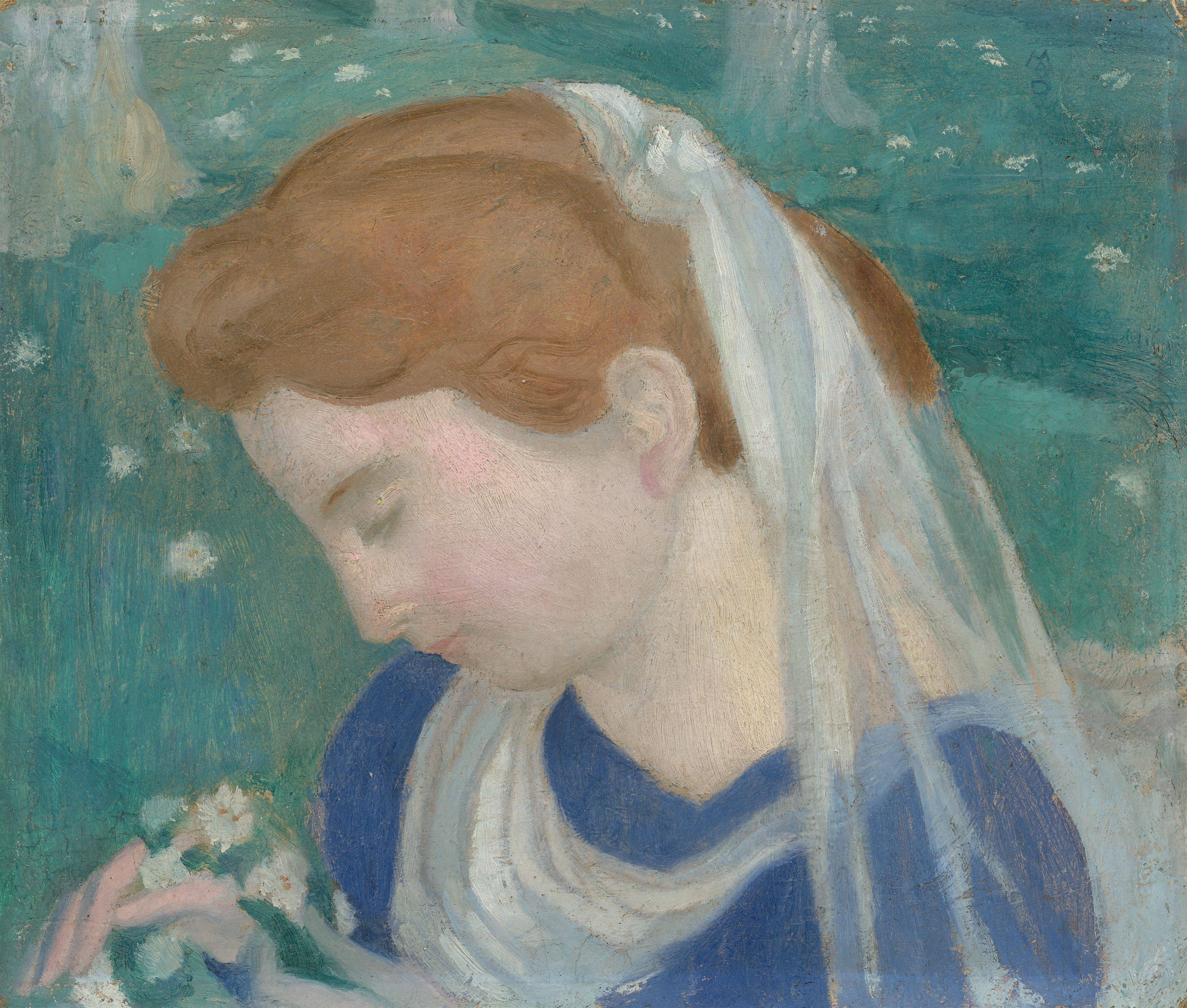
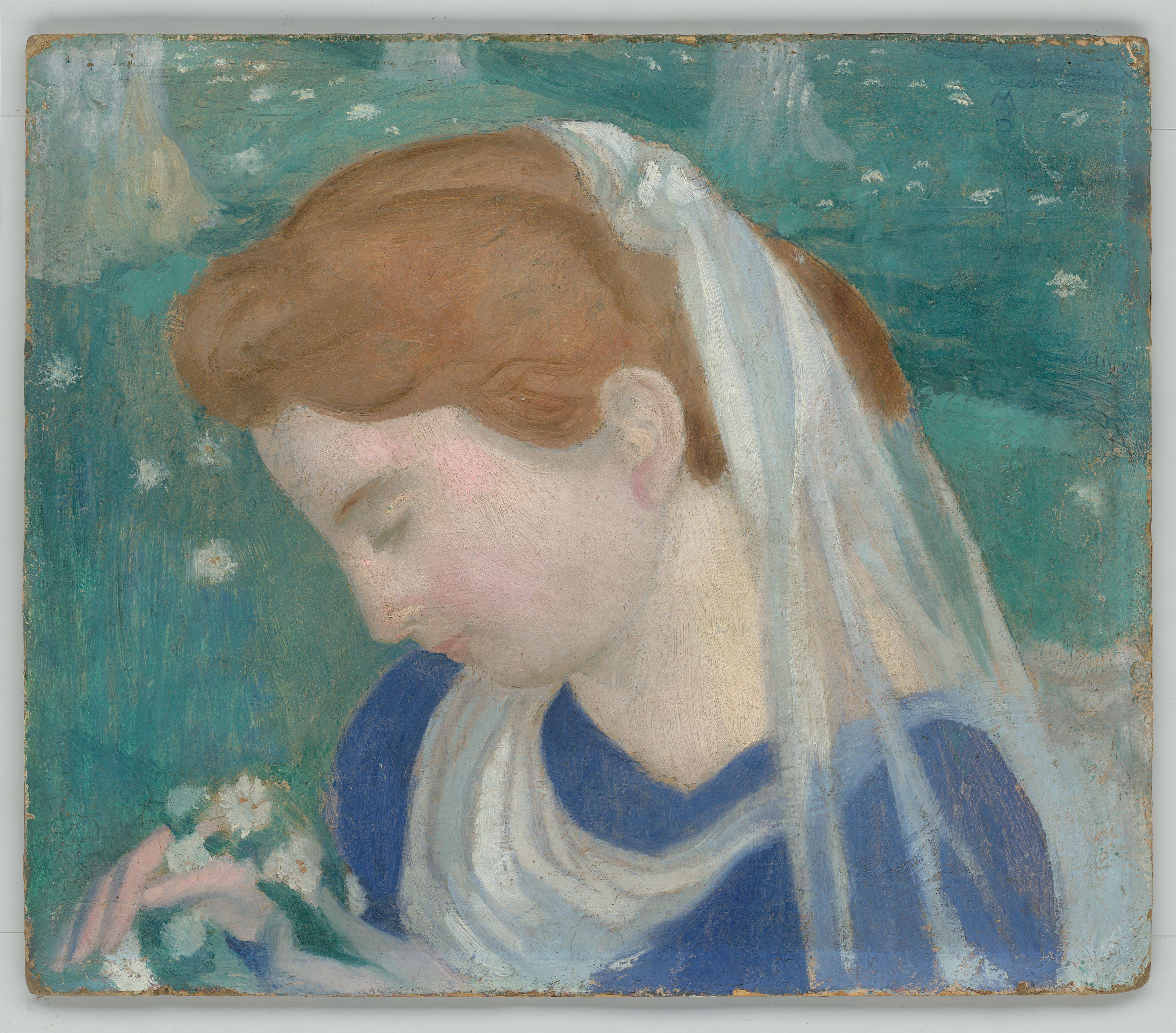
It is a great pleasure to be able to present ‘Young Woman with a Veil’, such an important work from Denis’s estate. Like the significant work ‘Girl with a Doll’ (Bremer Kunsthalle), this painting was created around 1895/96. In 1895, Denis visited Italy for a second time (following his first visit in 1890) and had studied the works of the Renaissance, particularly those of Piero della Francesca. His wife Marthe (née Meurier, married in 1893) gave birth to their daughter Noelle in 1896, following the birth of their son Jean-Paul (1894). The fact that the painting has remained in the family across generations may suggest that the artist held it in particular personal regard. The young woman’s head, seen in strict profile as she leans towards a handful of white meadow flowers, is depicted as a flat form against a green meadow dotted with trees (only their bases are visible) and white flowers (like little stars). In her pinned-up, reddish-blonde hair, she wears a knotted veil that falls loosely over her left shoulder and drapes away from her neck over her azure-blue dress. The intimate tenderness of this painting is moving due to the unhurried closeness conveyed both by the moment in which the beautiful woman, with her eyes closed, turns towards the little flowers in her hand, and by the immediacy of the painting, which eschews any illusionistic artifice. The moment becomes eternity, depicted in the contemporary avant-garde painting of its time.
As early as 1971, Günter Busch, the eminent director of the Kunsthalle Bremen, drew attention - on the occasion of an exhibition on Maurice Denis - to the significance of the ‘Nabis’ and, in particular, of this artist for the development of Modernism right up to the present day. Not only do the Parisian ‘Art Nouveau’, the ‘Vienna Secession’ and ‘Munich Art Nouveau’ find their precursors here, but ‘Informel’, ‘Minimalism’ and ‘Concept Art’ also appear to have their foundations already laid out (Günter Busch, Maurice Denis, 1971, pp. 7-9). Maurice Denis, the ‘Nabi of beautiful icons’, masterfully conveys his message to us through the enchantingly moving work ‘Young Woman with a Veil’: ‘Yes!’ one is tempted to exclaim here - ‘everything is contained in the beauty of a work’. Anna Ahrens
Subject to change - Please refer to our conditions of sale.