
Lot
2937
Arolsen 1804 – 1874 Munich
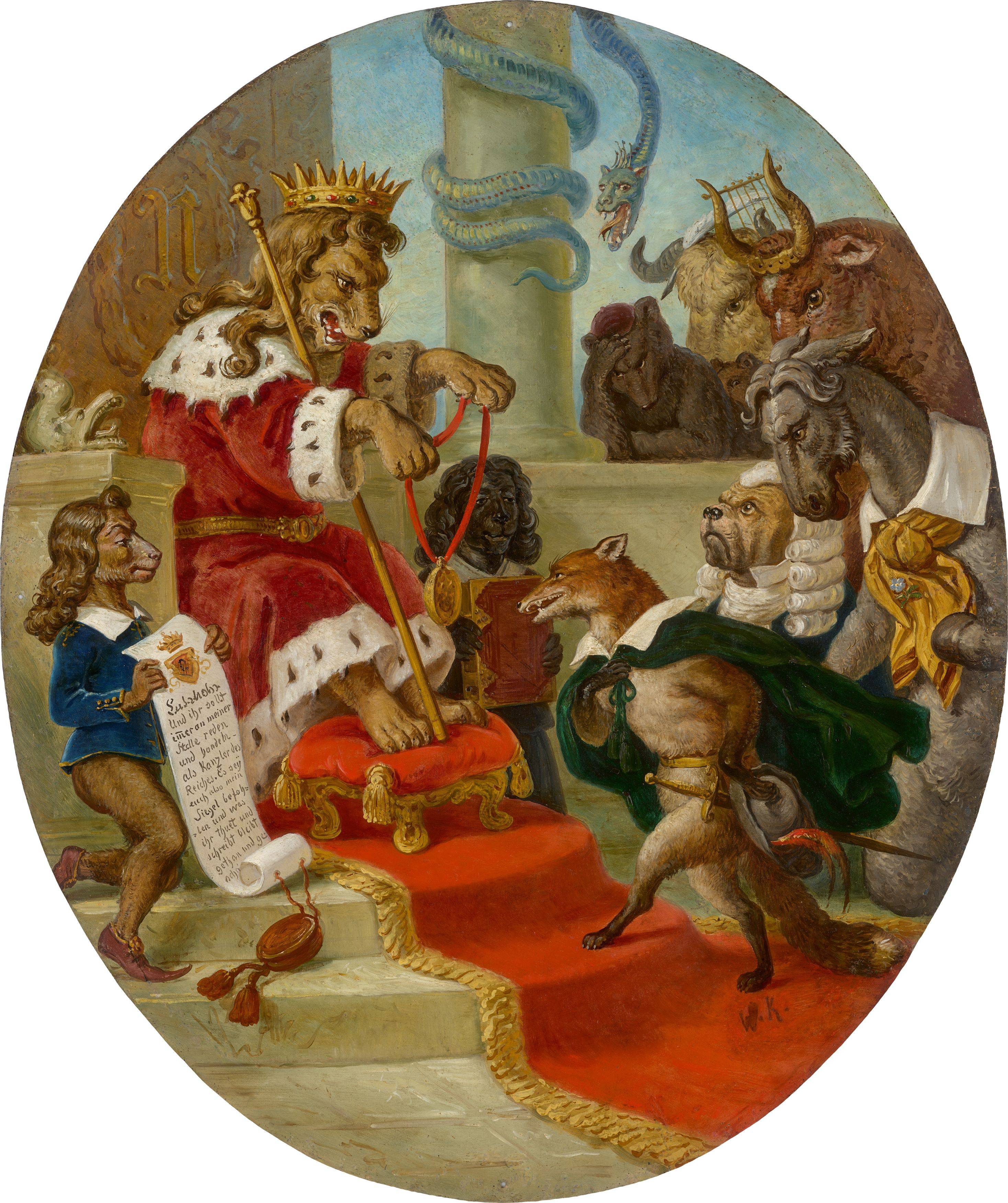
Reineke Fuchs is Pardoned by King Nobel. Circa 1841/42

Background:

Background:


Background:

We would like to thank Dr. Herbert W. Rott, Bayerische Staatsgemäldesammlungen, for kindly providing additional information
Condition Report: Beautiful, harmonious overall impression. The colours are fresh and vibrant. Under UV light, several retouches can be seen, particularly around the edges and in the upper sky. At the centre of the top, bottom, left and right edges of the image, there is a small hole where a mount once was. (LM)
Private Collection, North Rhine-Westphalia
Auction 385: Werke alter Plastik, Gemälde alter und neuzeitlicher Meister. Cologne, Kunstauktionshaus Lempertz, 8.–11.12.1936, cat. no. 1008a („Episode aus dem Tier-Epos ,Reinecke Fuchs'")
Reineke Fuchs is a master of deception. Through cunning, lies and rhetorical skill, he has robbed numerous animals of their possessions and time and again saved himself from precarious situations. Now he stands before King Nobel, the lion, who is passing judgement on his misdeeds. But instead of punishment, a surprising twist awaits the fox. He is pardoned and readmitted into courtly society. Wilhelm von Kaulbach captures this moment and sums up the biting irony of the story: of all people, the scoundrel gets off scot-free!
„Reineke Fuchs“ is one of the classics of European literature. The story dates back to the Middle Ages, long before Johann Wolfgang von Goethe reworked it into a verse epic in 1794. In twelve cantos written in rhyming hexameter, he tells the story of the cunning fox, who manages to extricate himself from seemingly hopeless situations.
Around fifty years later, Wilhelm von Kaulbach built on Goethe’s adaptation. Commissioned by the publisher Johann Georg Cotta, he began creating the illustrations (36 main plates and numerous vignettes) in 1840 for a magnificent new edition, which was published in 1846. The steel engravings were executed by Hans Rudolf Rahn and Adrian Schleich. Cotta’s edition was a great success and played a key role in making Goethe’s epic accessible to a wide audience. As the 19th century progressed, the book became a staple in almost every child’s bedroom.
Yet Kaulbach by no means confined himself to merely illustrating the plot. His animals wear the clothing and insignia of a human class-based society. Their gestures and facial expressions betray calculation, an awareness of power and vanity. With pointed allusions to the politics and social life of his time, Kaulbach continues Goethe’s satire, taking aim at both the Biedermeier petty bourgeoisie and the behaviour of the nouveau riche. What is more, he lends the verses a new relevance. A pencil drawing relating to our painting is held in the collection of the Lenbachhaus in Munich (inventory no. G 13366). FMG
Subject to change - Please refer to our conditions of sale.