
Lot
2913
1803 – Berlin – 1860
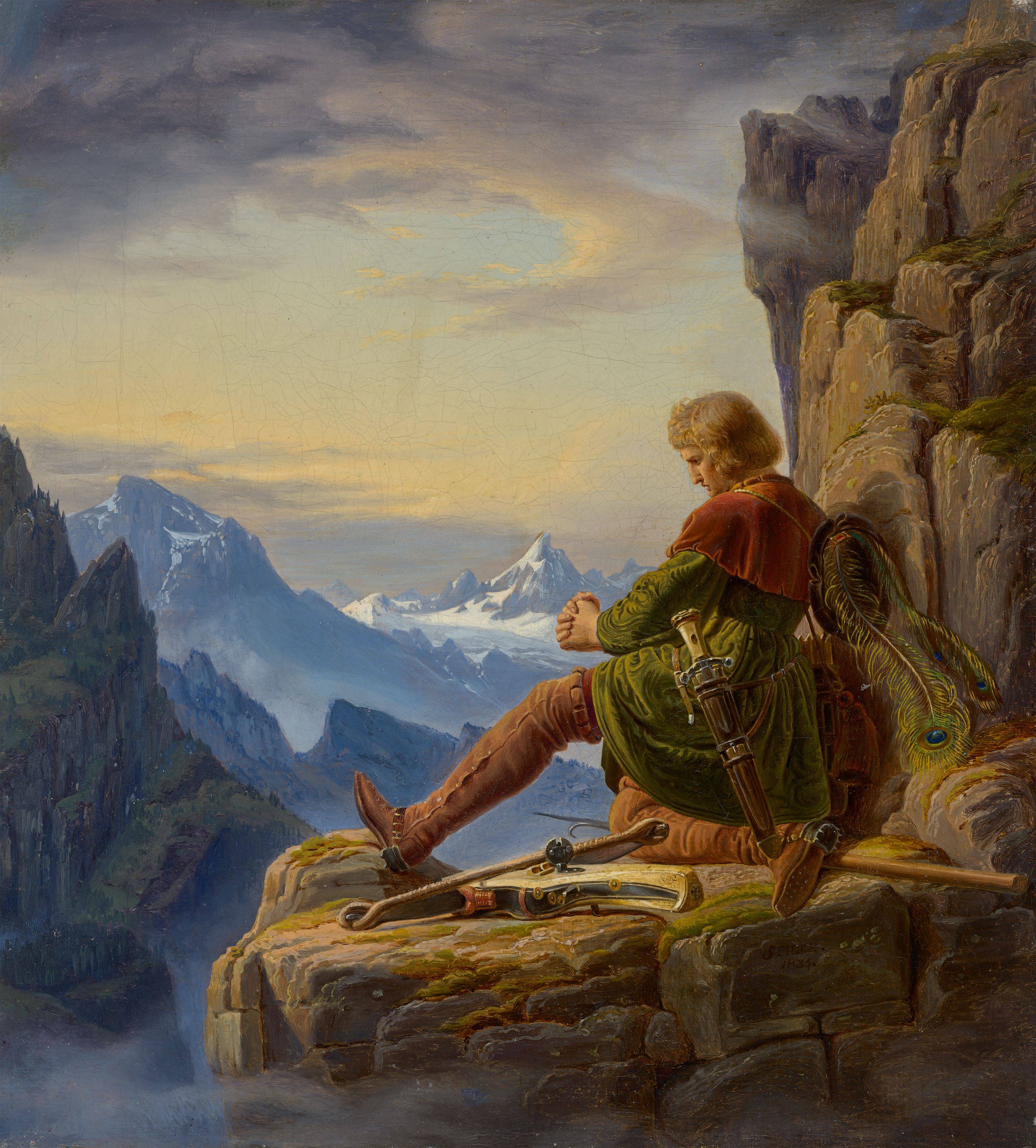
Emperor Maximilian on Martinswand. 1835

Background:

Background:

Background:
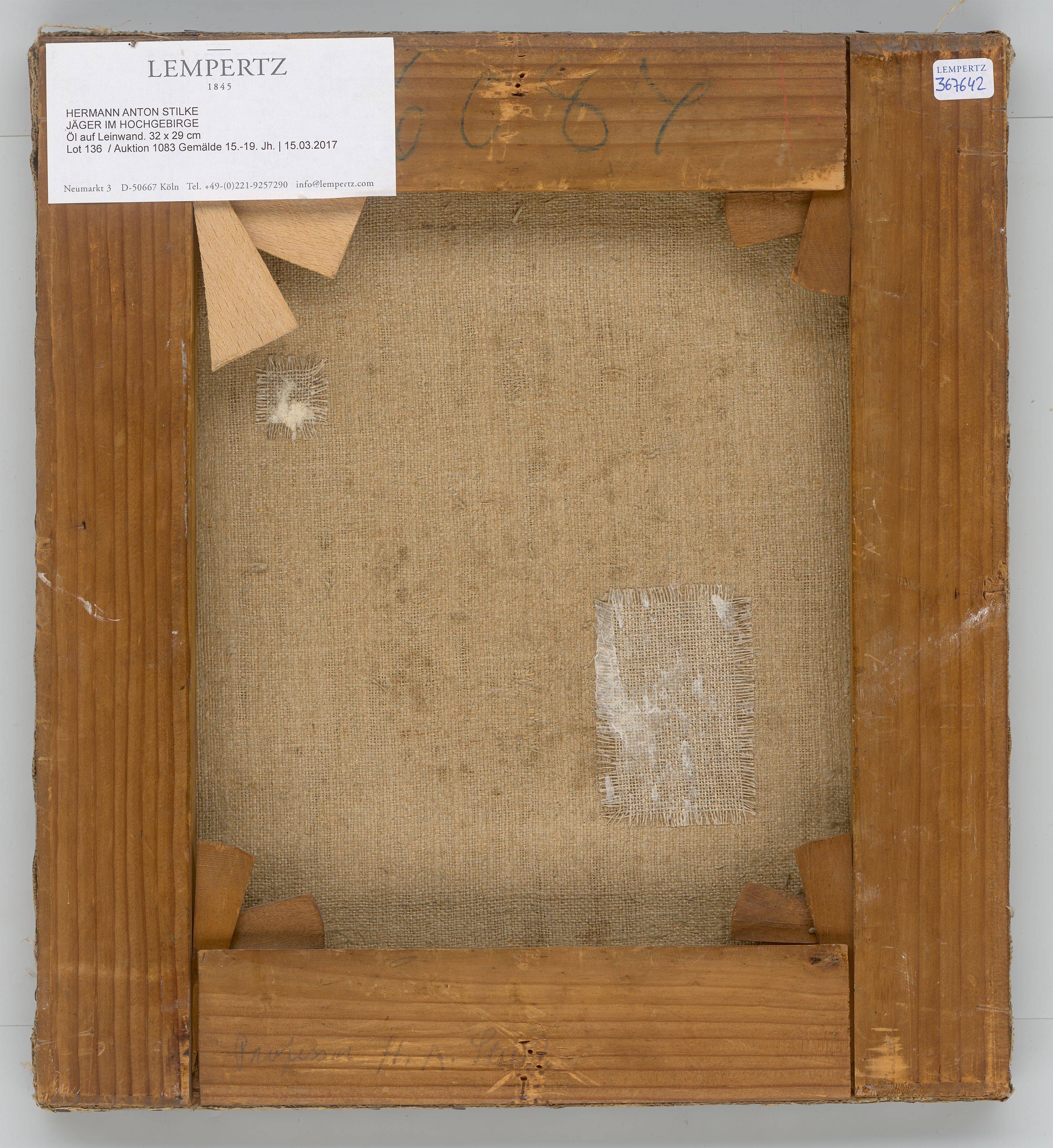
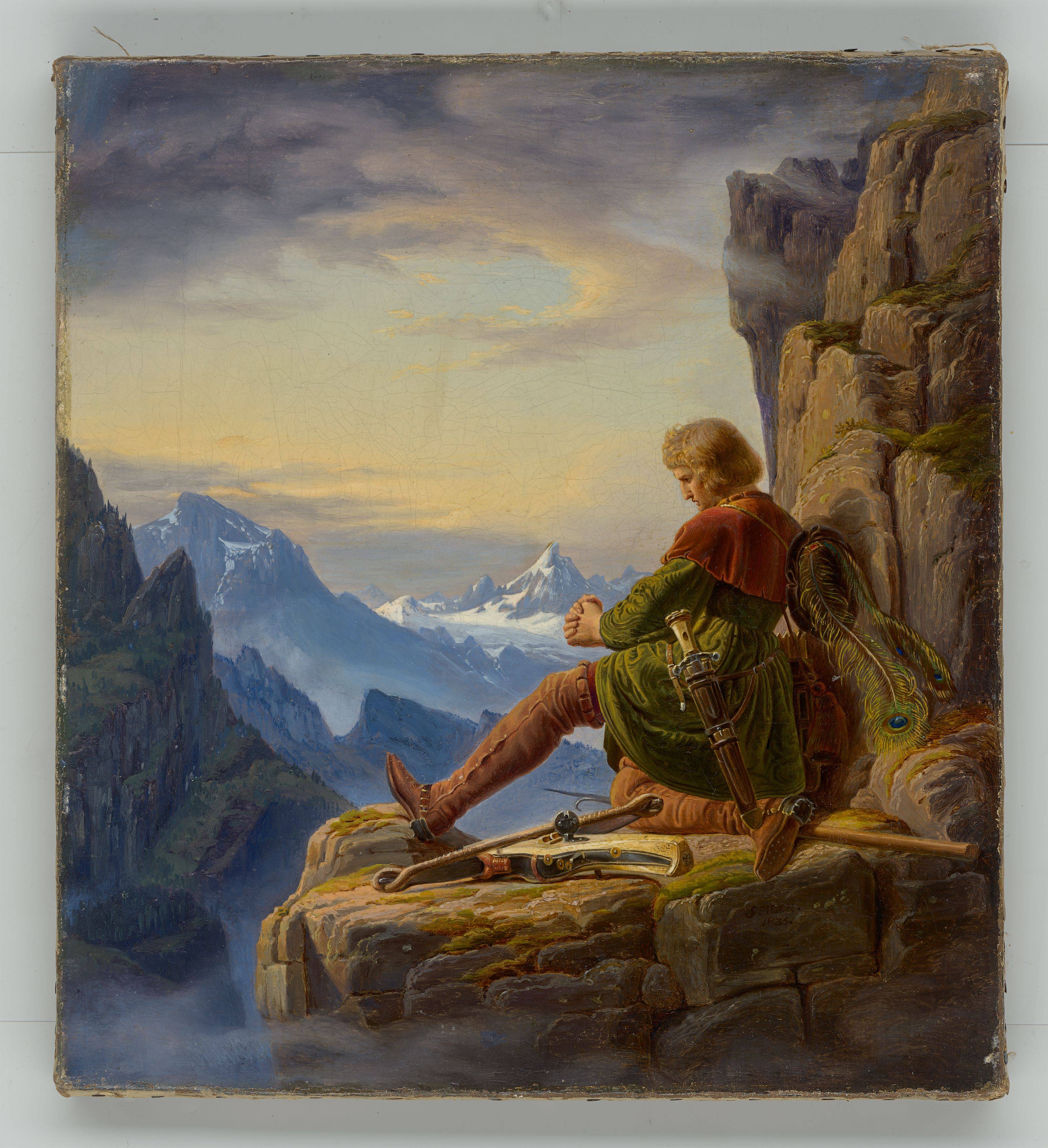
Condition Report: In good condition. The colours are clear and fresh. Under UV light, only very isolated, sporadic retouching can be seen along the right-hand edge of the picture, as well as a slightly larger area of retouching in the sky above the head; these are not visible to the naked eye. There is minimal rubbing in places along the edges beneath the frame cover. In places, there is very fine, barely perceptible craquelure. The edge of the stretcher frame is faintly visible all the way round the front. The canvas is unlined and appears to be on the original stretcher frame (the wedges have been partially replaced). The canvas has been reinforced with patches in two places on the reverse. Very beautiful, harmonious overall impression
Private Collection, North Rhine-Westphalia
Seated on a narrow rocky ledge, high above the abyss of the Martinswand in Tyrol, Emperor Maximilian I sits with his hands clasped in prayer, his gaze fixed downwards into the yawning chasm. Enclosed by steep rock faces, every path seems blocked to him. His hunting gear lies beside him; before him lies the overwhelmingly beautiful Alpine landscape. ‘You are nothing, God is everything,’ wrote Carl Gustav Carus in his „Nine Letters on Landscape Painting“ (1815–1824) about the feelings one experiences on a mountain summit. And it is true: the Emperor is alone, a prisoner amongst the rocks, helplessly at the mercy of the forces of nature. Only God’s grace can save him now.
Stilke’s depiction refers to the famous account of Maximilian’s hunting adventure on the Martinswand near Zirl, close to Innsbruck. According to legend, in 1484 the passionate hunter had climbed too high into the rocks whilst pursuing a chamois and could neither go forward nor back:
„Wherever he turned, the daring gentleman faced certain death […] The sheer height of the location made it impossible to come to his aid with a rope; not even all the stonecutters combined could have carved a path up there in a month. The gentleman could see his servants standing and walking below, but they were unable to help him. For two whole days and nights he hoped for rescue. At last he realised that up here there was no escape from death, and he longed for the holy last rites […] The prayer was not in vain, for on the third day the pious gentleman heard a noise nearby, and when he turned in that direction, he saw a young man in peasant’s clothes crawling towards him and carving a path through the rock. The young man held out his hand and said: ‘Take heart, gracious sir! – God still lives, and He can and will save you. Just follow me and do not be afraid!’ So Maximilian followed his guide and soon came upon a path that led him back to his own people […] In the crowd, the guide immediately disappeared; he could no longer be found anywhere, and so he had to be regarded as an angel and a messenger of God […] Emperor Max later had the spot on the Martinswand carved out and, in memory of God’s divine aid, had a crucifix forty feet high erected there, which still stands today.“ (Legends from Tyrol, Collected and edited by Ignaz V. Zingerle, Innsbruck 1891, No. 977, p. 558)
Hermann Stilke was one of the most distinguished representatives of the first generation of the Düsseldorf School of Painting and also worked there as a teacher for a time. For his painting, he chose the dramatic climax of the legend: the moment of existential fear and uncertainty in the face of impending doom. The focus – typical of the Düsseldorf school’s Romantic-influenced historical painting – is not on the actual plot of the legend, but on the relationship between humankind and nature, the struggle with primal forces, and the realisation of one’s own limitations in the face of the mighty creative force of nature. Despite his social standing, the Emperor appears as a vulnerable individual. God cares nothing for titles and honours. Stilke’s painting combines historical tradition and legend with the Romantic conception of nature, as formulated by Carus and others. The fact that he conceived and prepared the composition with particular care is evidenced by an accompanying drawing, which is held in a renowned private collection in northern Germany.
Subject to change - Please refer to our conditions of sale.