
Lot
17
Rosario de Santa Fé 1899 – 1968 Comabbio
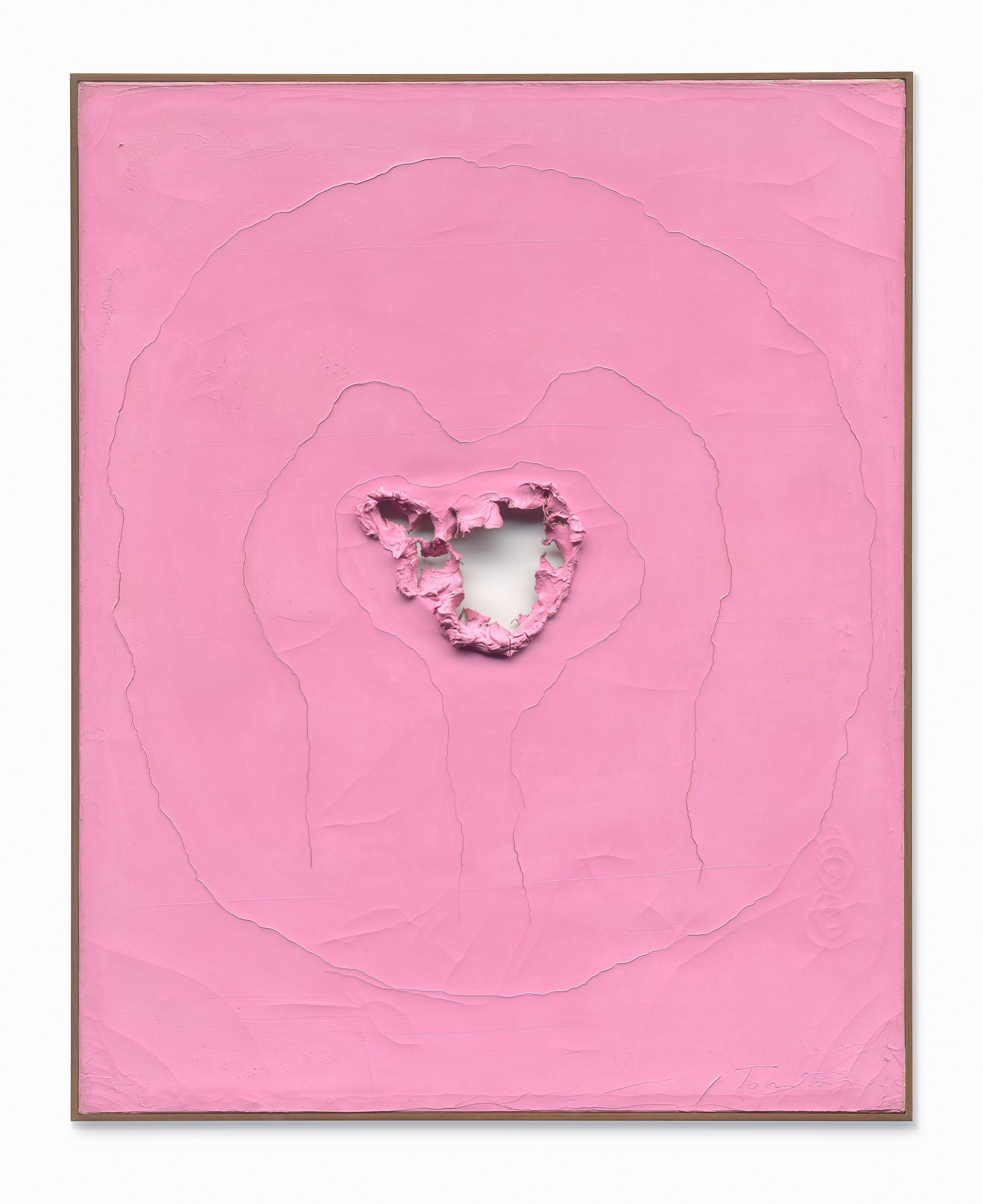
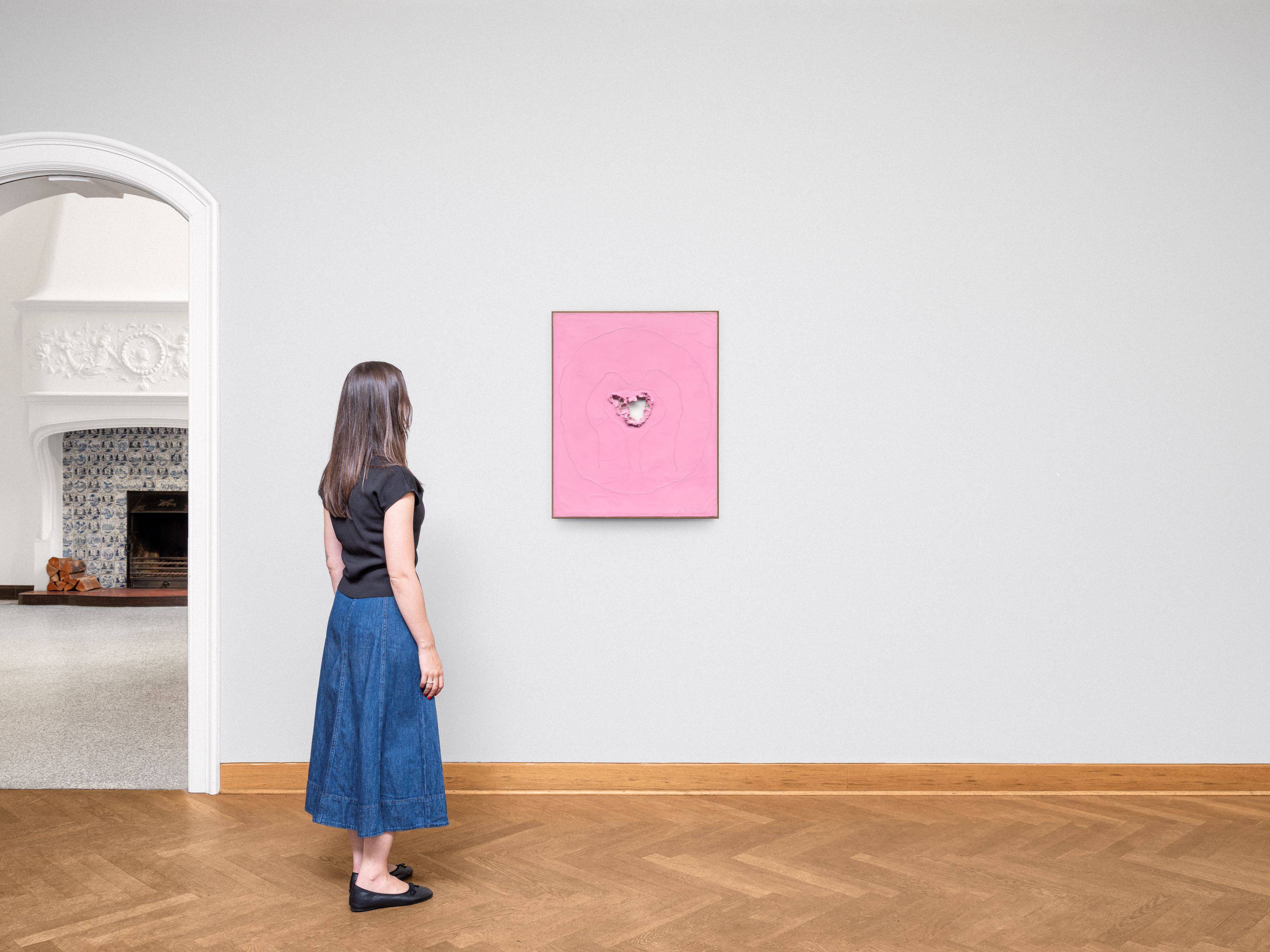
”Concetto Spaziale”. 1966/67

Background:


Background:

Background:
Estimate:
EUR 300,000
- 400,000
USD 337,000
- 449,000
Auction 378
Thursday, 26.11.2026, 6:00 PM
Request condition report
Ask our specialists
Galleria Il Punto, Torino / Giuseppe Malvolti, Torino / Penna, Biella / Private Collection, North Rhine-Westphalia (acquired in 1985 at Gallery 44, Kaarst)
A Hole in the Cosmos of Art: Lucio Fontana’s Breakthrough into the Third DimensionWhat a bold act of creation: a monochrome canvas whose energy has lost none of its intensity, even today, sixty years after it was made.
Lucio Fontana was the first artist who deliberately disrupted the surface of his canvases, not only revealing their material nature but also making the process of their creation visible. Until then, paintings had served as vehicles for an illusion of spatial depth. Through his interventions, Fontana transformed his works into objects that engage directly with space. His paintings do not represent space; they bring it into being. In 1949, Fontana created his first „Concetto Spaziale“, opening an entirely new and previously unknown chapter in art history. He maintained that the idea was what mattered most: a single cut or a single hole would have been enough. This statement illustrates the importance he attached to the conceptual foundation of his art. Ultimately, he placed the idea above its execution, establishing the principles of conceptually oriented art as early as the beginning of the 1950s.
Our intensely coloured „Concetto Spaziale“ of 1966/67 belongs to the significant group of works known as the Olii, which Fontana created from the mid-1950s through the 1960s. It demonstrates how, depending on the colour and the execution of the holes, sensory perception remains inseparable from the conceptual dimension of Fontana’s art. Katharina Hegewisch aptly observed in 1987: “Fontana’s art is conceptual, controlled and scientifically oriented. But it is also wild, sensuous and Baroque.”
The deliberate act of piercing a hole in the still-wet, malleable layer of paint, meticulously planned and positioned by the artist, remains permanently legible to the viewer. Unlike his cuts in the canvas, which Fontana often prepared by sitting in concentrated contemplation before the blank surface for several hours, the holes (Buchi) were carefully planned openings executed in a matter of seconds in the still-fresh, undried canvas. Immediately afterwards, Fontana enlarged them with circular movements, pushing the thickly applied, fresh paint into raised ridges around their edges. The fine incisions encircling the holes suggest that Fontana released his energy through a meditative gesture. In our „Concetto Spaziale“, the paint becomes a sculptural mass: vivid and charged with energy, it confronts the viewer as though still in motion, evoking the emergence of a new cosmos.
The openings and ridges of paint and canvas, which extend into space and suggest depth, resonate with Fontana’s early sculptural works, which he created primarily in terracotta until 1948. In these early sculptures, which shaped a full twenty-five years of his artistic career, Lucio Fontana, born the son of a sculptor, drew on religious and Baroque imagery. He believed that the art of the past had found solutions to the representation of space and time that remained valid and unsurpassed. In his Technical Manifesto, he emphasised:
“Today we need an art based on new conceptions. The Baroque pointed us in this direction. The grandeur with which its representations incorporate the concept of time into the visual arts remains unsurpassed. Figures seem to detach themselves from the surface and reach out into space through their movements. This artistic conception arose from the new ideas about existence that people were beginning to develop. For the first time, the physics of this period recognised the nature of dynamics. Movement was discovered as a principle inherent in matter, through which the universe could be understood” (Lucio Fontana, as recorded by Guido Ballo).
In a total of seven manifestos, Fontana set out his new demands for the visual arts in detail. The first major manifesto of Spazialismo, or Spatialism, known as the Manifesto Blanco, was written in 1946 during his teaching tenure at the Altamira Escuela Libre de Artes Plásticas in Buenos Aires, in collaboration with Jorge Romero Brest and a group of his students. The signatories called for a new, dynamic art informed by contemporary scientific discoveries, in which spatial and chromatic composition would be combined with sound, light and movement. All forms of experience were to be brought together in a synthesis: “Colour as a spatial element, sound as a temporal element, and movement unfolding in time and space are the fundamental forms of the new art, which encompasses the four dimensions of existence.”
In his final interview with Tommaso Trini on 19 July 1968, Lucio Fontana stated:
“So, if any of my discoveries is of some importance, it is the ‘hole’ […]. By ‘hole’ I mean breaking through the boundaries imposed by a picture frame, and at the same time the fact that everyone is free in their conception of art. […] I think in another dimension. The ‘hole’ is this dimension. I say dimension because I cannot think of a better word. I make a hole in the canvas to leave behind the inherited pictorial formulas, painting itself and the traditional conception of art, and to escape, both symbolically and materially, from the prison of the flat surface.” AGT
Subject to change - Please refer to our conditions of sale.