
Lot
11
Wedel 1870 – 1938 Rostock
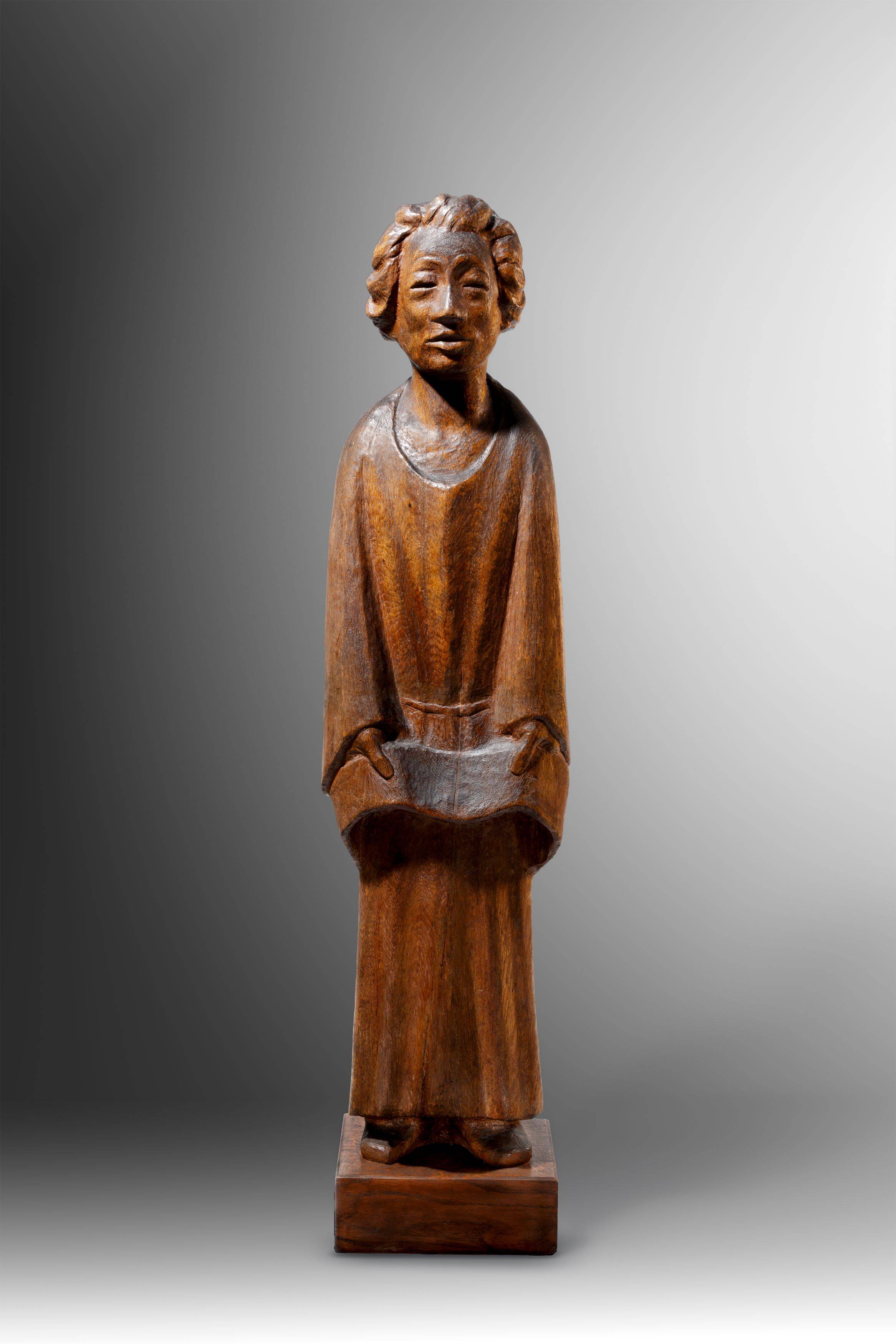
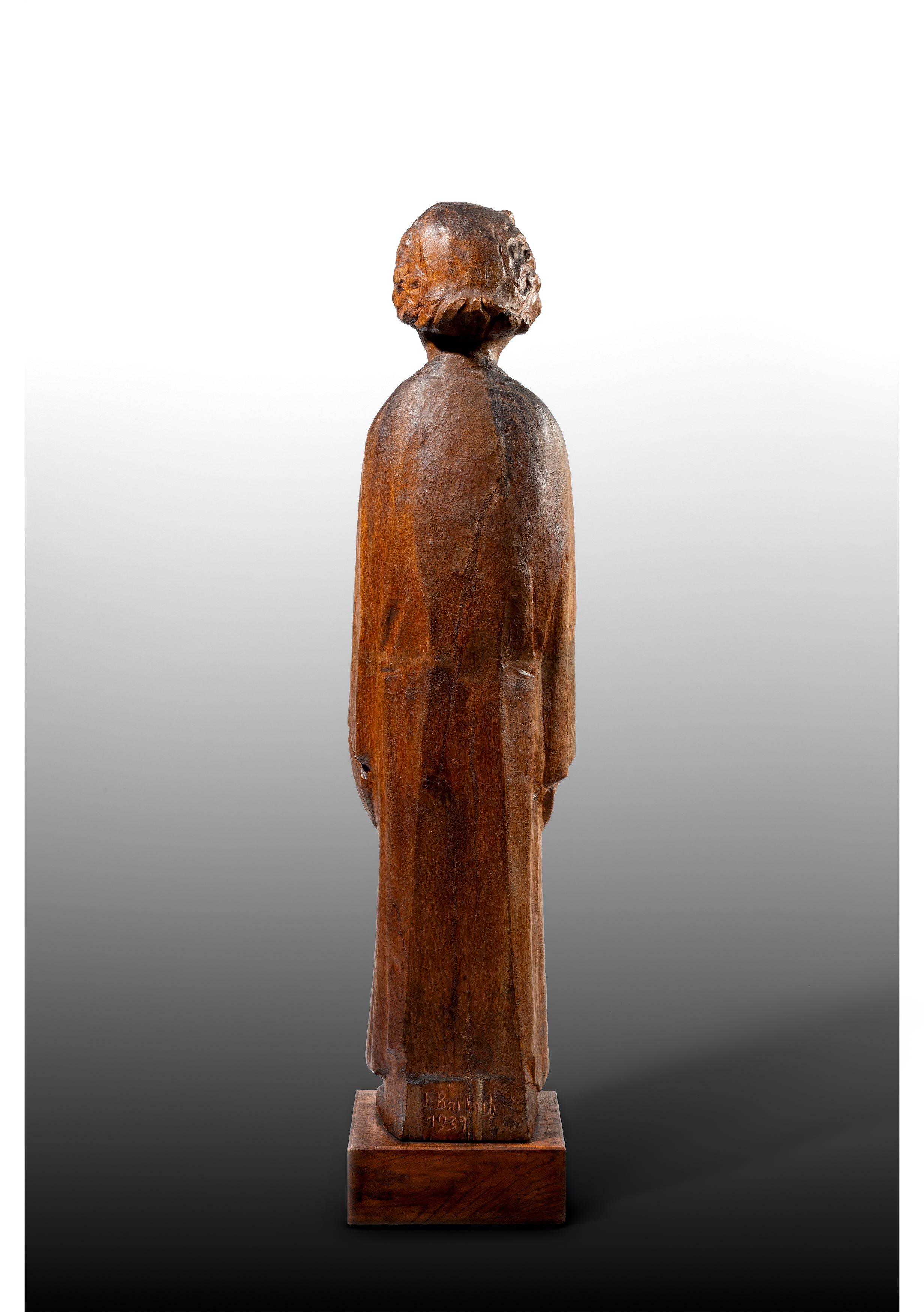
”Der Sänger”. 1931

Background:

Background:

Background:
Estimate:
EUR 200,000
- 300,000
USD 225,000
- 337,000
Auction 378
Thursday, 26.11.2026, 6:00 PM
Request condition report
Ask our specialists
According to the catalogue raisonné some prepararory works for the figure were executed by Bernhard A. Böhmer after the workshop model (Laur 488) the final execution was carried out by the sculptor.
Galerie Ferdinand Möller, Berlin (received presumably by the artist) / Private Collection, North Rhine-Westphalia (acquired from the above-mentioned, thence by descent to the present owner)
Ausstellung Berliner Kunst. Munich, Neue Pinakothek, 1935, cat. no. 10 (as part of „Drei Heilige von St. Annen, Lübeck") / Ernst Barlach. Bremen, Kunsthalle Bremen, 1959, cat. no. 43
A Singer for Lübeck – Ernst Barlach's Design for St Catherine's Church
"In Lübeck, Heise is planning figures by me for 16 arched windows of St Catherine's Church, and he seems enterprising enough to see it through. The thought of 16 almost life-size figures leaves me breathless. But of course the whole thing can't be done in one go; the commissions will surely come in one after another," Ernst Barlach wrote to his cousin Karl Barlach on 22 October 1929 (Ernst Barlach. Leben und Werk in seinen Briefen, Munich 1952, p. 152).
This ambitious project began in October 1929, when the art historian Georg Heise, director of the Behnhaus in Lübeck, visited Barlach in Güstrow to acquire a major work for his still young museum. While looking through drawings, he discovered individual figures that play a prominent role in Barlach's work, and at once conceived the bold idea that Barlach should create figures for the blind niches on the west façade of the Gothic church. Shortly afterwards, Barlach made a view of the façade with twelve figures. In his conception they did not represent a choir of saints. Instead, he sketched "God-seekers of suffering humanity", a special community of human types. Among them were a Man Waiting, a Man Blessed with Grace, a Blind Beggar on Crutches, a Sinner, a Dancer, a Woman in the Wind and also a Singer.
Barlach threw himself into the work, producing sketches and first small-scale figures, while his patron Heise published "Der Lübecker Barlach-Plan" (The Lübeck Barlach Plan), the title of his article in the journal "Museum der Gegenwart", edited by Ludwig Justi, and in other periodicals of the day. In 1930, the Blind Beggar on Crutches was completed as the first figure. Designs and drawings existed for the others, and an architectural model with three occupied niches served as an illustration. The final figures were planned to be larger than life, over two metres tall, cast and fired as dark-glazed clinker.
After initial enthusiasm, broad public opposition formed and the financing threatened to collapse. Georg Heise therefore took on the commission with Barlach privately and ordered two of each figure: one for the blind niche and one for sale, in order to finance the daring project. In the end, the cycle of figures originally planned for St Catherine's Church could only be realised in greatly reduced form. Only three figures reached the intended façade niches in the early 1930s. Ultimately, only the Hamburger Kunsthalle under Gustav Pauli acquired two clinker figures in 1932, at 8,500 Reichsmarks each: "Frau im Wind" (Woman in the Wind) and "Der Sänger" (The Singer). In 1937, these two terracottas were also confiscated in the course of the Nazi "Degenerate Art" campaign. In 1939, Bernhard A. Böhmer acquired them for Güstrow from the group of artworks at Schönhausen Palace that had been classified as financially "exploitable" on the international market. Today they belong to the Ernst Barlach Stiftung there.
"Der Sänger" holds a special place within this body of work. Barlach first developed the figure as a smaller plaster model and also had it cast in bronze. This was followed by the larger-than-life clay version, about 207 cm tall, intended for the façade niche: a demanding process. Bernhard A. Böhmer, himself a trained sculptor, assisted Barlach in transferring the figures to this large format; a photograph shows him working on the clay model of the Blind Beggar.
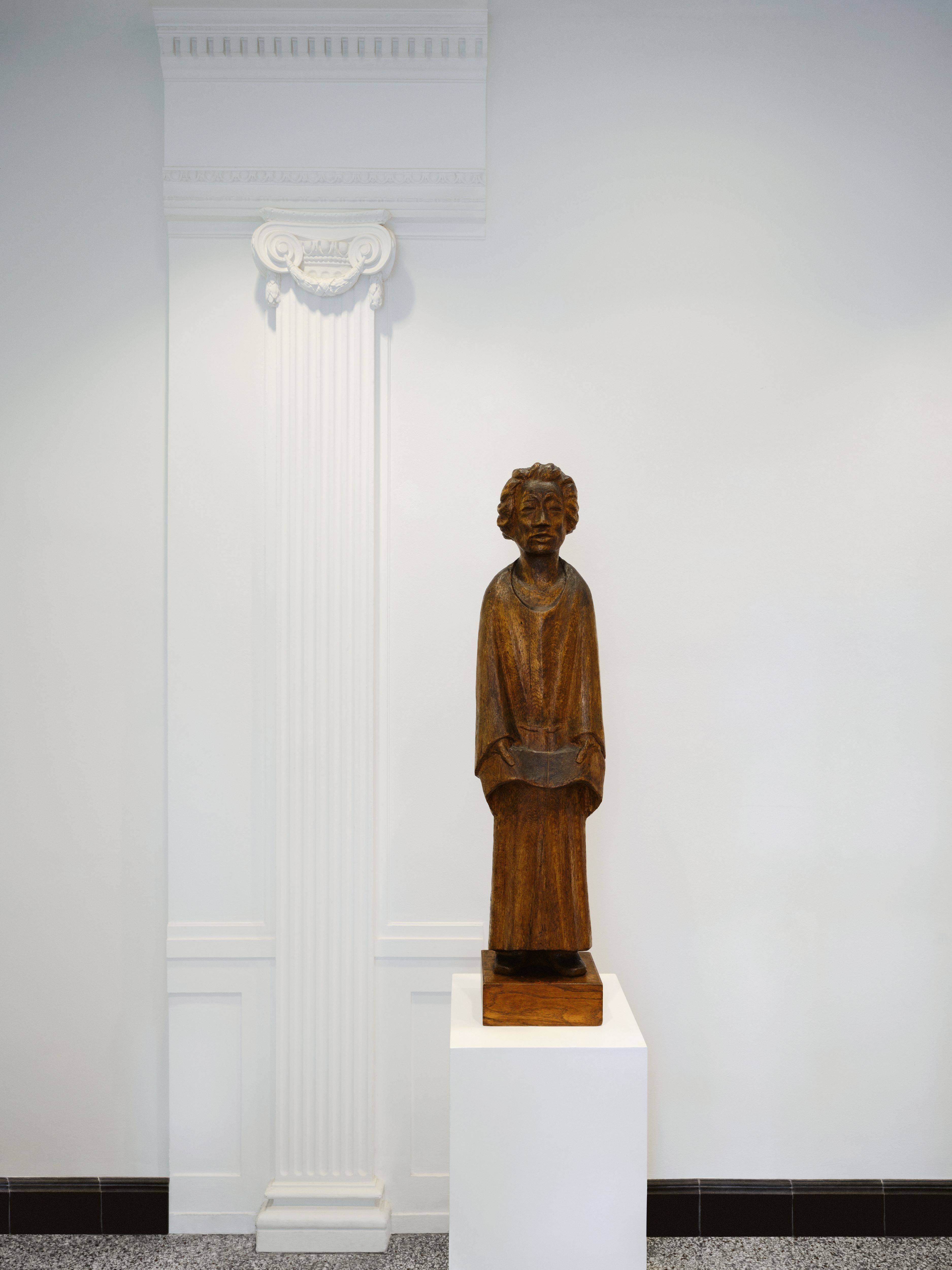
It was in this context that Barlach also created the present wooden version. At 119 cm including the plinth, it is more than twice the size of the plaster or the bronze. This makes it an exceptional unique piece, since it remains the only figure in wood to have survived from the group of figures for the façade of St Catherine's Church.
According to Elisabeth Laur, the editor of the catalogue raisonné, Böhmer is also said to have helped Barlach here by roughing out a first version from the hard oak trunk. Later, in 1937, Böhmer told his friend Hugo Körtzinger, likewise a painter and sculptor, "that, driven by the artist's impatience, he transferred Barlach's clay models into wood, in order to make it easier for the master to continue working on the pre-shaped wooden 'blanks'" (quoted in: Meike Hoffmann (ed.): Ein Händler „Entarteter" Kunst. Bernhard A. Böhmer und sein Nachlass, Berlin 2010, p. 7, note 11). After moving to Güstrow in 1924, Böhmer formed an almost symbiotic working and living partnership with Ernst Barlach. After the death in early 1926 of Paul Cassirer, Barlach's influential Berlin dealer since 1908, Böhmer became Barlach's secretary. He was responsible not only for marketing his art but also took on tasks in his studio. Marga, whom Böhmer had married in 1917, had by then become Barlach's partner.
After the divorce in 1927, Marga Böhmer and Ernst Barlach lived together in the studio house until his death in 1938. She remained in Güstrow after the war and looked after his estate until her own death in 1969. Bernhard Böhmer, for his part, married Hella Ottes from Rostock in 1931, yet remained part of the "studio community" with Barlach in Güstrow.
As early as 1907/08, working in wood took a central place in Barlach's sculpture. Alongside bronze and ceramics, wood became one of his essential means of expression. With "Der Sänger", Ernst Barlach proves himself an outstanding sculptor in wood, one who knew how to renew the art of sculpture and stir emotions in those who view his work. Mario von Lüttichau
Subject to change - Please refer to our conditions of sale.