
Lot
13
Königsberg (today Kaliningrad) 1867 – 1945 Moritzburg
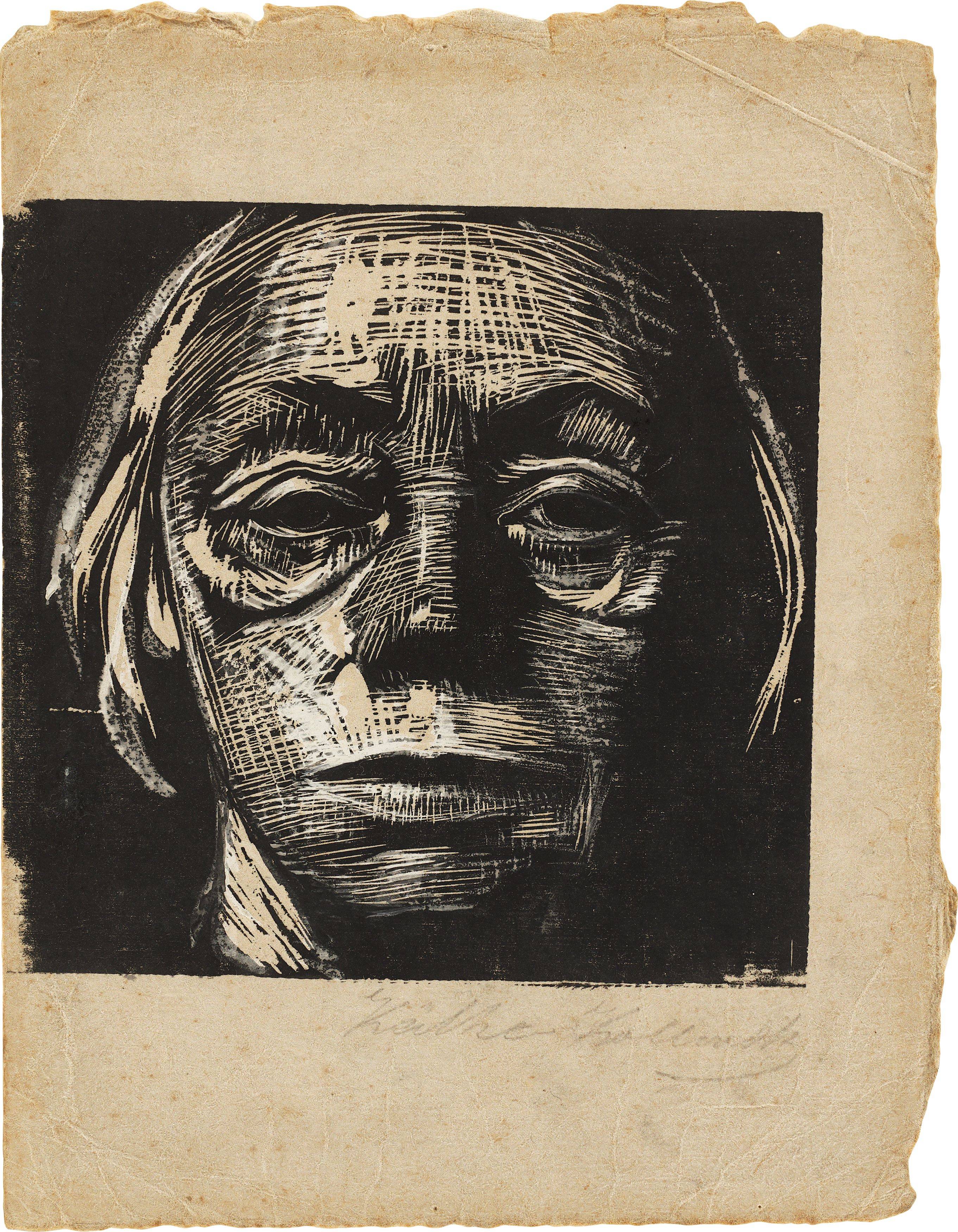
”Selbstbildnis von vorn”. 1922/23

Background:

Background:


Background:
Estimate:
EUR 18,000
- 24,000
USD 20,200
- 27,000
Auction 378
Thursday, 26.11.2026, 6:00 PM
Request condition report
Ask our specialists
Private Collection, Saxony (acquired circa 1970, thence by descent to the present owner)
Käthe Kollwitz created more than 100 "self-images" over the course of her life. On the one hand, they are documents of self-examination. At the same time, they serve as a playground for formal experiments in which the artist shows what she can do. She underlined this again and again throughout her life by rendering her face with the pen, the brush, lithographic crayon on stone or, as in the present case, by cutting it into wood with the gouge. And not least, these self-portraits are aimed at us, the viewers, so that the artist and her work stay in our memory. They are images with signal effect, instantly calling to mind the themes of her art. With all the subtlety inherent in her self-portraits, Käthe Kollwitz succeeded at the same time in turning her face into a brand.
The present reworked woodcut shows precisely how she proceeded in her creative process. In her catalogue raisonné, Alexandra von dem Knesebeck lists a total of 14 different states of the block. Kollwitz thus made many changes, most of them very small, to arrive at a version she considered final. Let us pick out two changes that she made here in opaque white on the trial proof of the fourth state. With two brushstrokes she enlarges the head on the left-hand side (from the viewer's standpoint), but she does not carry the continuation of the hair on the right-hand side over into her further work on the block. Yet a much smaller correction has a far greater effect. The right eye, until then a black oval, receives a finely curved light line marking the iris. Only now does the eye truly come alive, for the gaze acquires a direction and a counterpart: us.
Käthe Kollwitz had a stupendous mastery of woodcut technique. The way she drew light out of darkness through white-line cutting, bringing her face to life, is unrivalled in modern printmaking. Martin Schmidt
Subject to change - Please refer to our conditions of sale.