Lot
64
Waldheim, Saxony 1877 – 1947 Berlin
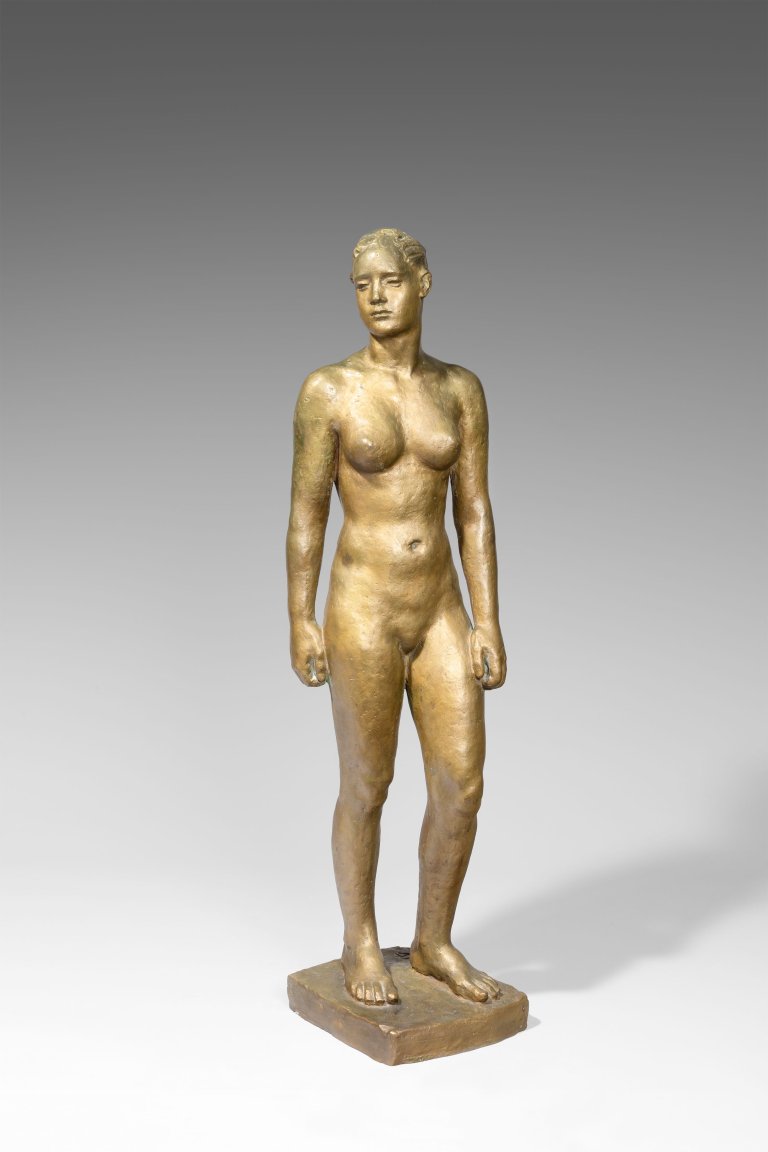
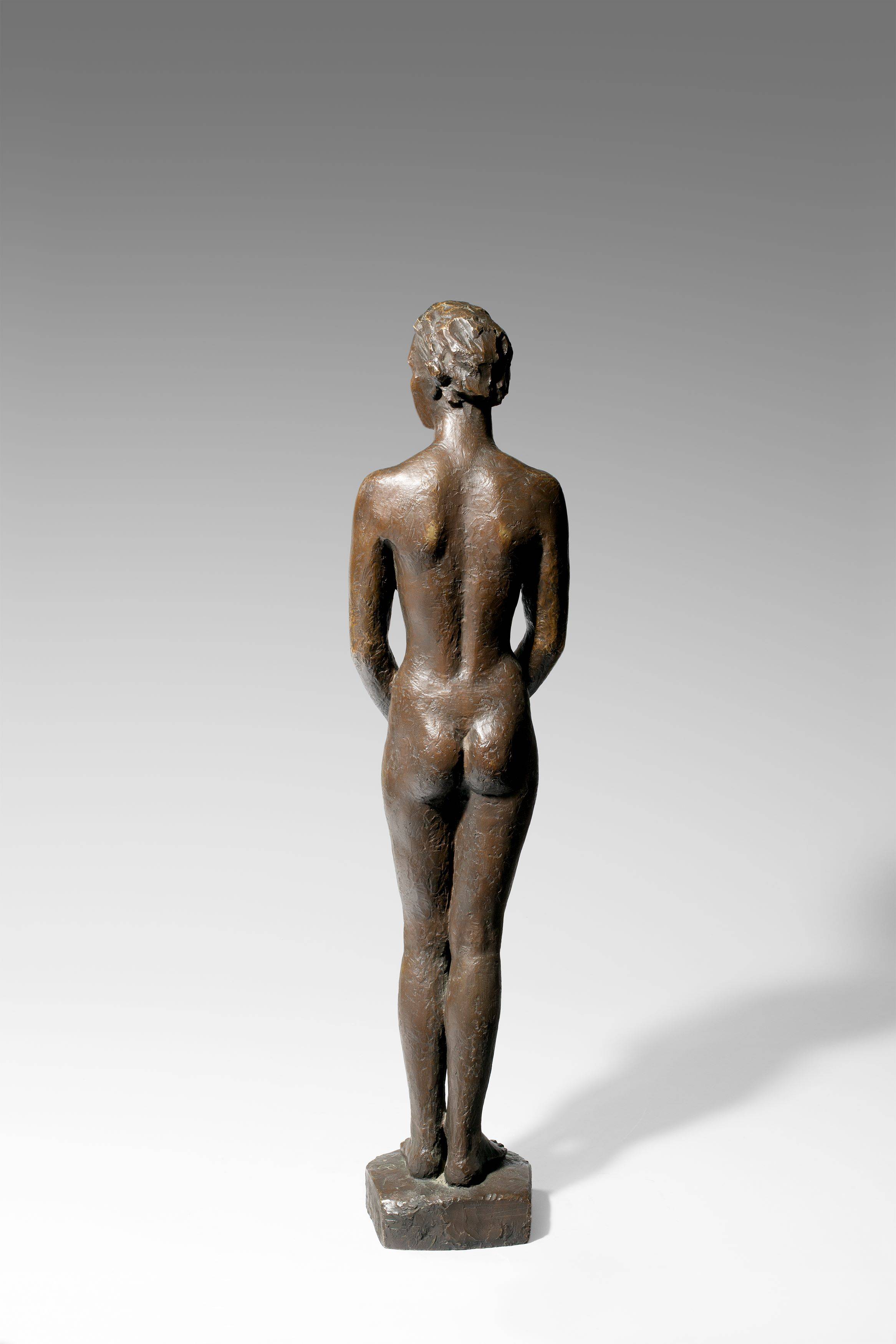
”Junge Frau”. 1929

Background:


Background:
Estimate:
EUR 50,000
- 70,000
USD 56,200
- 78,700
Auction 378
Thursday, 26.11.2026, 6:00 PM
Request condition report
Ask our specialists
Private Collection, Southern Germany (acquired in the 1950s, thence by descent to the present owner)
With his famous "Tänzerin" (Dancer) of 1911/12 and his "Tänzerinnen-Brunnen" (Dancers' Fountain) of 1922, Georg Kolbe gave expression to the pioneering spirit of a new, young generation. Only a few years separate the expressive, animated dancer of the fountain from the self-contained figure "Junge Frau" (Young Woman), which the sculptor created at the end of the 1920s. In between came the sudden death of Kolbe's wife Benjamine in 1927 and his move from the lively Tiergarten district to the quieter Westend of Berlin. Despite his withdrawal, the appeal of Kolbe's work remained undiminished, and the public was fascinated by the unusual movements and rotations of his figures. In March 1930, Alfred Flechtheim's Berlin gallery held a solo exhibition presenting a cross-section of Kolbe's sculpture, including his most recent development. There, among numerous floating, falling and flying nudes, the "Junge Frau" could be seen for the first time.
She stands upright and calm, her head turned slightly to the side. Her weight rests lightly on one leg, while the other is placed loosely beside it. Her hands, folded in front of her body, create the impression of a closed, inward-directed movement that lends the sculpture a concentrated, almost contemplative presence. At the same time, the body is modelled with great sensuality: soft, flowing forms merge into one another, while the finely differentiated surface produces a lively play of light and shadow. Kolbe dispenses with expansive gestures and dramatic movement, yet on the other hand he shows no idealised ancient Venus, but a young woman of the late Weimar Republic. The strikingly individual facial features and the relatively short hair, swept back, suggest that the sculptor was working with a specific physiognomy. Classical image of humanity and modern appearance combine into a unity that no longer needs any overarching idea or symbolism. Susanne Schmid
Subject to change - Please refer to our conditions of sale.