Lot
22
Tapiau/East Prussia 1858 – 1925 Zandvoort
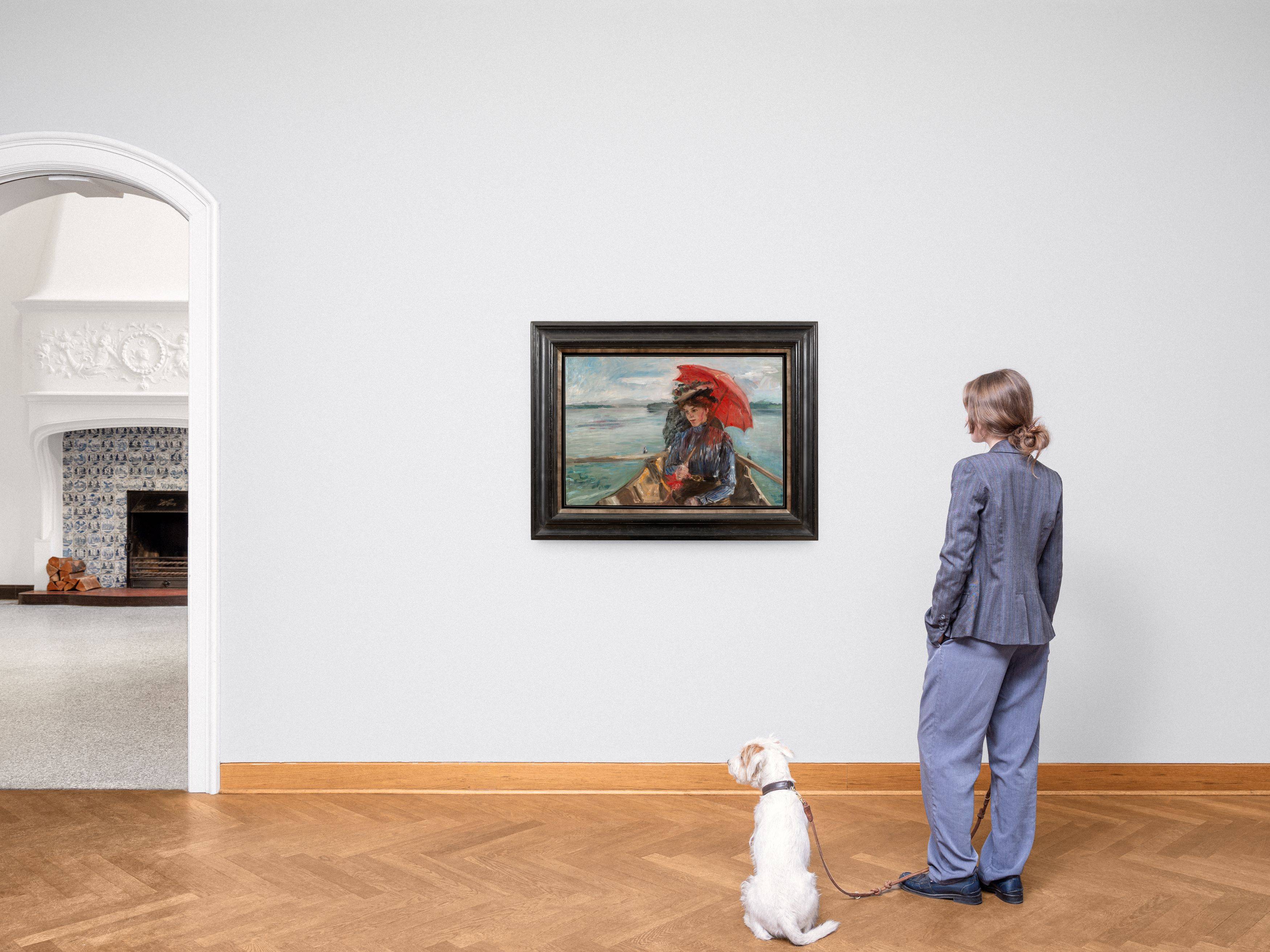
”Fräulein Heck” (In a Boat on Lake Starnberg). 1897

Background:


Background:


Background:


Background:
Estimate:
EUR 200,000
- 300,000
USD 225,000
- 337,000
Auction 378
Thursday, 26.11.2026, 6:00 PM
Request condition report
Ask our specialists
Max Halbe, Munich (at the latest since 1913) / Karl Schmidt, Cologne (1952) / Private Collection, Baden-Wuerttemberg / Private Collection, Berlin / Private Collection, Northern Germany / Private Collection, Berlin
Lovis Corinth. Katalog der Ausstellung des Lebenswerkes. Berlin, Galerie Paul Cassirer in den Räumen der Secession, 1913, cat. no. 41 (“Auf dem Starnberger See“) / Lovis Corinth. Ausstellung von Gemälden und Aquarellen zu seinem Gedächtnis. Third editon. Berlin, Nationalgalerie, 1926, cat. no. 51 ("Frau Max Halbe im Kahn“) / Lovis Corinth. Gemälde, Aquarelle, Zeichnungen und druckgraphische Zyklen. Cologne, Wallraf-Richartz-Museum in der Kunsthalle, 1976, p. 25, cat. no. 7, plate 6
Alfred Rohde: Der junge Corinth. Berlin, Rembrandt-Verlag, 1941, p. 132, ill. 96, and p. 142 / Otto Brües: Der Schirm und die Maler. Divertimento zu 30 Reproduktionen von Darstellungen des Schirms in der Kunst. Hrsg. v. Karl Schmidt. Cologne, Droste Verlag, 1952, n. p., w. ill. (“Kahnfahrt auf dem Starnberger See") / Gottfried Sello: Qualität jenseits des Fortschritts. Corinth-Ausstellung in Köln. In: Die Zeit, 6.2.1976, no. 7, w. ill. / Thomas Corinth: Lovis Corinth, Eine Dokumentation. Tübingen, Verlag Ernst Wasmuth, 1979, p. 53 and p. 164 / Horst Uhr: Lovis Corinth. Berkeley/Los Angeles/Oxford, University of California Press, 1990, p. 107 and p. 109, ill. 72 / Exh. cat.: Lovis Corinth. Vienna, Kunstforum der Bank Austria, und Hanover, Forum des Landesmuseums, 1992/93, p. 41, ill. 4 (not exhibited)
"Presence and Life" – Lovis Corinth's Mastery "en plein air"
"Sur le motif. Peindre en plein air" was the title of one of the finest exhibitions of recent years (Fondation Custodia, Paris). Ever since the great period of upheaval around 1800, artists all over Europe had been leaving their studios to paint in the open air. The Paris exhibition was so stimulating because it did not ask about art schools or local contexts in the narrower sense. Instead, it consistently asked about the motifs that the most diverse artists, from Scandinavia to southern Europe, sought out again and again on their forays into nature. Whenever they painted one another at work, there is always the parasol, planted somewhere in the landscape as protection against sun and rain.
Painting "en plein air" was surely one of the most important and far-reaching steps in the development of art towards modernism. Leaving the studio was not least a step into freedom, leaving behind all the textbooks and time-honoured collections of models in order to find one's own way to the picture. The focus shifted from looking back to the past to engaging with one's own present. The change in art followed the change in society, its constantly new views, needs and preferences, and not least the rapid technological developments (rail connections, ready-mixed oil paints in tubes and much more). This consistent focus on the present soon brought the city into the motifs of plein-air painting as well, especially the increasingly fashionable life of the "city dwellers", between bustling activity, cultural and social amusements and the pleasures of the countryside. We think of the wonderful Manet, of the Impressionists and their successors, whose lifelike mastery still moves us today.
Lovis Corinth is without question one of the outstanding German artists to be named here. Corinth means "presence and life", as Max Osborn observed on the occasion of the large-scale retrospective of his oeuvre at the Nationalgalerie in Berlin in 1926 (quoted in: Heckmann, Corinth 2026, p. 28). The director, Ludwig Justi, had also selected the painting "Fräulein Heck im Boot auf dem Starnberger See" (Miss Heck in a Boat on Lake Starnberg) for this important exhibition. For him, Corinth was "the greatest German painter of his time" (Justi 1931; quoted ibid., p. 11). The Berlinische Galerie is currently presenting his work in an impressive comprehensive exhibition ("Lovis Corinth. Dann kam Berlin"). It is a celebration of his painting, just like this bravura piece, which Corinth painted while still living in Munich and on Lake Starnberg.
On a summer day with drifting clouds, a rowing boat glides across a lake, propelled by an oarsman in the bow who is glimpsed only fleetingly as a shadowy silhouette. The movement and a light breeze can be felt. We see a young woman sitting directly in front of us, in the middle of the open wooden boat. She is fashionably dressed in an azure blouse (probably of silk) with long, slightly puffed sleeves, and a matching brown, slightly flared skirt, adorned at the waist by a black belt with a gold clasp. Her thick brown hair is gathered up under a hat trimmed with flowers. Her left hand rests gently on her thigh; with her right she holds an apple-red parasol, its shaft resting on her left shoulder close to her neck. It is open and shelters her head from behind, and its red is reflected in the shoulders of her blouse. Turned slightly to the left (from our point of view), she is caught in a moment of thoughtful pause, of withdrawal into herself. Her head is tilted a little. Her eyes look at the water before her and at the same time inwards, as if she were reflecting on what has just been said, or daydreaming, for a moment entirely within herself and not in this real situation at all. She is completely unaffected. Simply herself.
Directly in front of her sits the painter Lovis Corinth, who has invited her on this outing. He observes her very closely and translates the mood of this recognised and captured moment into paint. With a quick, sure brush he decides on the composition and the painterly treatment of his companion and of the surrounding landscape. He captures her posture, her appearance, her expression, the reflections of light and the colours, without becoming petty or disturbing this precious moment, let alone constraining or freezing it. We look over his shoulder, sit with him in the boat, and experience the situation through his eyes, just as he perceived it.
As we know from Charlotte Behrend-Corinth's catalogue raisonné, the sitter is Bertha Heck, whom Corinth had asked to pose for him during a boat trip on Lake Starnberg. She was the sister of Luise, who had married the writer Max Halbe, co-founder of the Munich Volksbühne, and who herself held a central place in the social life of the art, literary and theatre scene around her husband. In the late 1890s, Corinth was on close terms with the Halbe family, as the wonderful breakfast scene in the Lenbachhaus attests. There, too, Bertha sits at the family table in the garden of Halbe's property in Bernried, then a popular meeting place of the Munich bohème (the fourth person is probably the poet and actor Karl Rössler). The relaxed atmosphere, with the washing still hanging on the line, conveys a moment captured with painterly assurance, one that vividly evokes the familial mood of a carefree summer morning among friends.
Corinth confidently dated this picture precisely to 28–31 August 1899. In doing so, he not only revealed his participation and his personal closeness to the family but also clearly demonstrated his talent as a plein-air painter. His sensitive portrait of Bertha Heck in the open boat on Lake Starnberg is closely related to this breakfast scene, painted two years later. Both paintings are among the masterpieces of his Munich oeuvre shortly before his move to Berlin. They show an artist intensely present in the moment, who knew how to seize an impression with enormous assurance, grasp it emotionally and translate it into paint in all its immediacy. Like the great French Impressionists, he developed a highly personal, distinctive handwriting that mirrors the dynamism of his creative drive and his personality as an artist.
The portrait of the young woman in the boat positively invites a brief look at the history of the motif. Claude Monet's famous studio boat naturally comes to mind at once, in which he travelled the Seine from Argenteuil from the mid-1870s. Painting on the water, which makes the reflections of natural light far more intensely perceptible, together with the mobility and the constant change of perspective, held enormous appeal for the Impressionist. Édouard Manet's famous painting "En Bateau" (Boating) was also created in Argenteuil, when he visited the younger Monet during the summer holidays of 1874 (Metropolitan Museum of Art, New York). The man in boating-club attire is probably his brother-in-law; the woman, according to Julius Meier-Graefe, may be Monet's wife Camille. Indeed, that summer Manet also portrayed Monet himself painting in his boat, with his wife Camille watching him (Neue Pinakothek, Munich). Monet had taken the idea of building such a studio boat to paint "en plein air" from Charles-François Daubigny, the important Barbizon painter whom he greatly admired. Daubigny had already knocked together a floating studio in 1857, which he called "le Botin" ("the little box").
The portrait of a young woman in a rowing boat also brings to mind Auguste Renoir's enchanting painting "Jeune Fille à la Barque" of 1877. Here the girl sits facing the painter in a similarly frontal pose, though holding two thin lines in her hands, and looks at us while canoeists speed through the water around her (private collection). There is a whole series of masterpieces to which Corinth's bravura piece of plein-air painting is linked. One last example may come as a surprise, but it belongs here just as much. Around 1870/72, Adolph Menzel, the outstanding portraitist of Berlin life, captured Emilie Fontane, wife of the writer Theodor Fontane, probably spontaneously, in a truly delightful small gouache, which he then gave her as a present. She sits reading at the rail of a steamer, so absorbed in her book that she notices neither the weather nor the people around her. A parasol, its shaft laid on her shoulder close to her neck, protects her from sun and wind. Even if Corinth certainly did not know this little gouache by Menzel, the two very different artists are united by their curiosity about life and their great talent for recognising special moments and capturing them in paint. The quiet, introspective moment of the young Bertha Heck in this boat on Lake Starnberg is an outstanding example of Corinth's mastery "en plein air". Anna Ahrens
Subject to change - Please refer to our conditions of sale.