Lot
6
Glatz/Silesia 1888 – 1965 Berlin
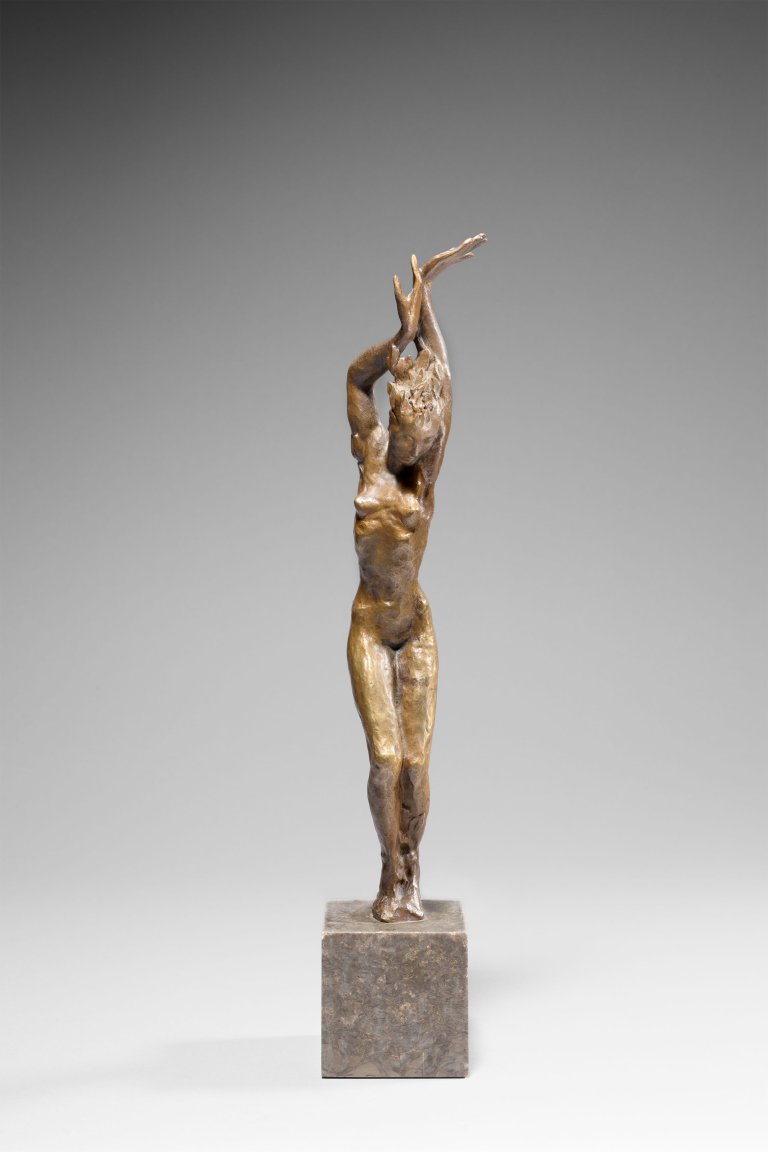
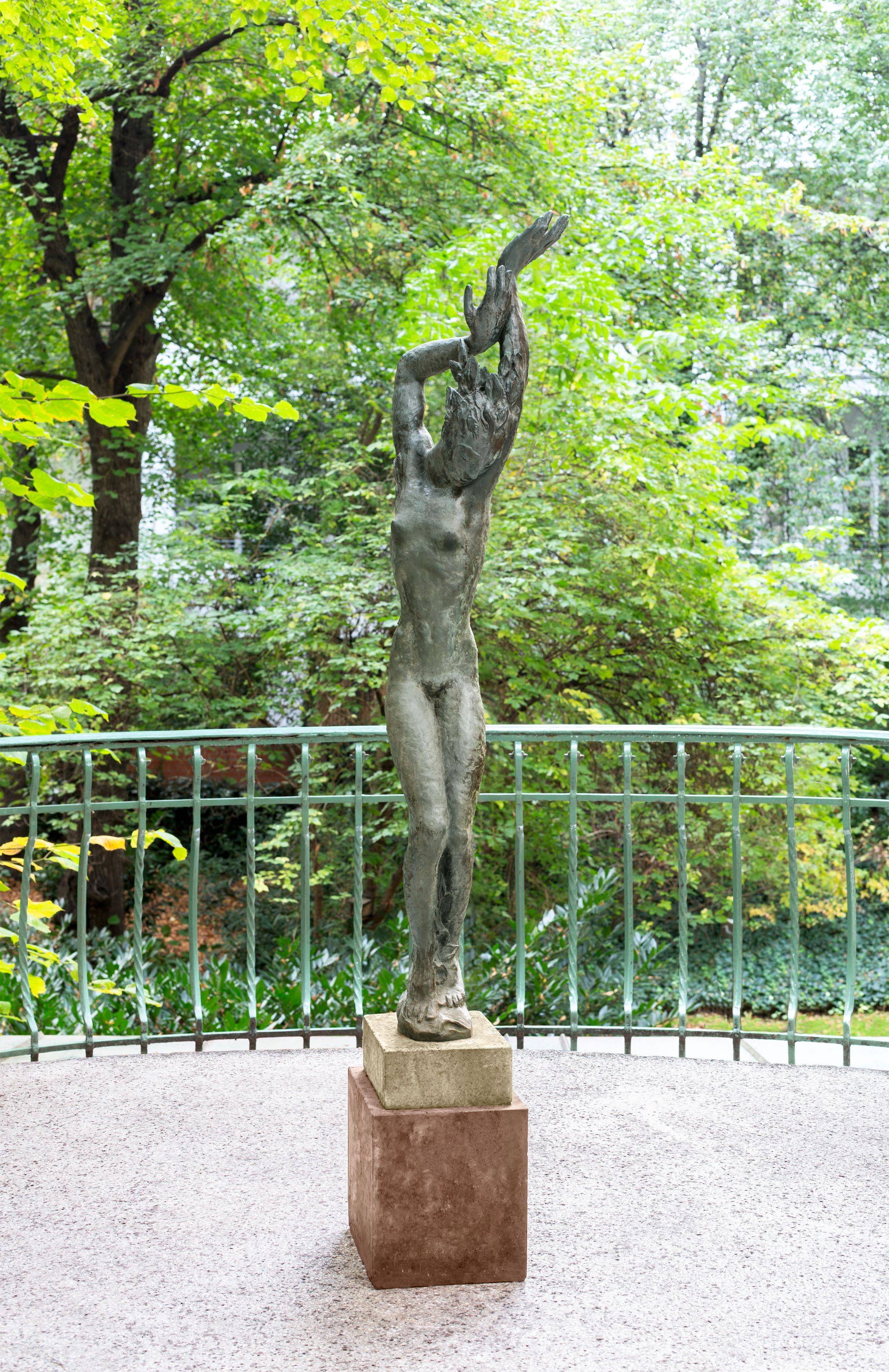
”Große Daphne”. 1930

Background:
Estimate:
EUR 250,000
- 350,000
USD 281,000
- 393,000
Auction 378
Thursday, 26.11.2026, 6:00 PM
Request condition report
Ask our specialists
Private Collection, North Rhine-Westphalia (acquired 1993 at Grisebach, Berlin, thence by descent to the present owner)
Auction 34: Ausgewählte Werke. Berlin, Villa Grisebach Auktionen, 26.11.1993, cat. no. 45, ill.
Renée Sintenis’s “Große Daphne”: Metamorphosis as an Expression of Female Self-Determination
In her bronze “Große Daphne”, Renée Sintenis captures the moment when the transformation begins. In a graceful pose reminiscent of a dancer, Daphne raises her arms above her head. Her hands, laid closely one over the other, herald the branching to come. Her hair has already taken on the form of individual laurel leaves, which wind up her arms like tendrils. Her slightly bent legs, held close together, seem about to turn into a trunk at any moment. Delicate laurel leaves sprout between her lower legs and climb up her left thigh.
An inner tension, fully lived through, can be felt in the modelling of the body: the slender figure, with its emphasised contours, turns slightly from the hip and unfolds in a fluid rhythm. Daphne tilts her head and lowers her gaze. Absorbed in the process of “becoming nature”, she now seems to surrender herself entirely to the transformation.
The metamorphosis of the young huntress Daphne, daughter of the river god Peneus, is one of the most famous episodes in Ovid’s “Metamorphoses” (I, 452–552). Sintenis was one of the first women artists to take up a subject that had inspired her male colleagues for centuries (ill. next page).
Born in 1888 in Glatz, Silesia, and raised in the idyllic landscape around Neuruppin, Sintenis lived with her parents in Berlin from 1905. She decided to become an artist at the age of just 17, and sculpture interested her most. Before the First World War, she made almost exclusively depictions of young, slender women, in which she was searching for herself. The small animal bronzes followed a little later.
After breaking with her parents, she changed. At first she lived with a friend, and as a sign of her independence she had her long braid cut off. From then on she wore a fashionable short haircut and increasingly embodied the prototype of the “New Woman”. At 1.80 metres tall, with her slender figure and striking features, she cut a remarkable figure. In 1917, Sintenis created the small version of Daphne, the culminating work of her group of female figures, which is particularly close to her own appearance. The work was a great success: her dealer Alfred Flechtheim planned an edition of 25 casts as well as three silver casts. “Daphne” remained the only human figure that Sintenis also executed on a large scale. In 1930, Carl Georg Heise, director of the Lübeck museum, commissioned a large version from the artist and had it installed as a gilded bronze in the garden of the Behnhaus. In 1939, the Museum of Modern Art in New York also acquired a cast of the “Große Daphne”, at a time when works by women artists were still rarely seen there.
In Greek mythology, Daphne flees from Apollo’s desire. To save herself, she begs her father for help and is finally transformed into a laurel tree. The metamorphosis saves her body and, beyond that, becomes an expression of female self-determination. Sintenis, too, strove throughout her life to live on her own terms. Although she was married to her mentor Emil Rudolf Weiß, she was rumoured to have had relationships with prominent women, among them the writer Christa Winsloe. Whether the glamorous life Sintenis led from the early 1920s suited her nature remains an open question. She herself repeatedly emphasised her shyness and her closeness to nature. Perhaps this is precisely where the artist is mirrored in her Daphne: in the tension between autonomy, public life and the longing for a deep bond with nature. Sandra Espig
Subject to change - Please refer to our conditions of sale.