
Lot
5R
Tula 1860 – 1938 Ascona
”Der Schnitter”. Circa 1910

Background:

Background:


Background:

Background:


Background:


Background:
Estimate:
EUR 400,000
- 600,000
USD 449,000
- 674,000
Auction 378
Thursday, 26.11.2026, 6:00 PM
Request condition report
Ask our specialists
From the estate of the artist, Ascona / Galerie Chichio Haller, Zurich / Private Collection, Switzerland (1969 acquired at Galerie Chichio Haller, thence by descent to the present owner)
Marianne von Werefkin. Ascona, Galleria Castelnuovo Trudi Neuburg-Coray, 1967, cat. no. 33 / Marianne von Werefkin, 1860-1938. Zurich, Galerie Chichio Haller, 1969, cat. no. 7 / Marianne von Werefkin. Leben und Werk 1860-1938. Ascona, Museo Comunale d’Arte Moderna; Munich, Villa Stuck; Hannover, Kunstverein; Berlin, Haus am Waldsee; Bad Homburg, Sinclair-Haus, 1988-90, cat. no. 53, ill. / Der Blaue Reiter und das neue Bild – Von der „Neuen Künstlervereinigung München“ zum „Blauen Reiter“. München, Städtische Galerie im Lenbachhaus, 1999, S. 321-328, ill. p. 326
Otto Fischer: Das neue Bild. Veröffentlichung der Neuen Künstlervereinigung. Munich, 1912, ill. pl. XXXV / Nicole Brögmann: Marianne von Werefkin. Œuvres peintes 1907–1936. Gingins, Fondation Neumann, 1996, p. 39, ill. 36 / Schlossmuseum Murnau, Brigitte Salmen (ed): Marianne von Werefkin in Murnau. Kunst und Theorie, Vorbilder und Künstlerfreunde. Murnau, 2002, p. 65, ill. 19)
From an Impression of Nature to a Symbol – Marianne von Werefkin’s "Der Schnitter"
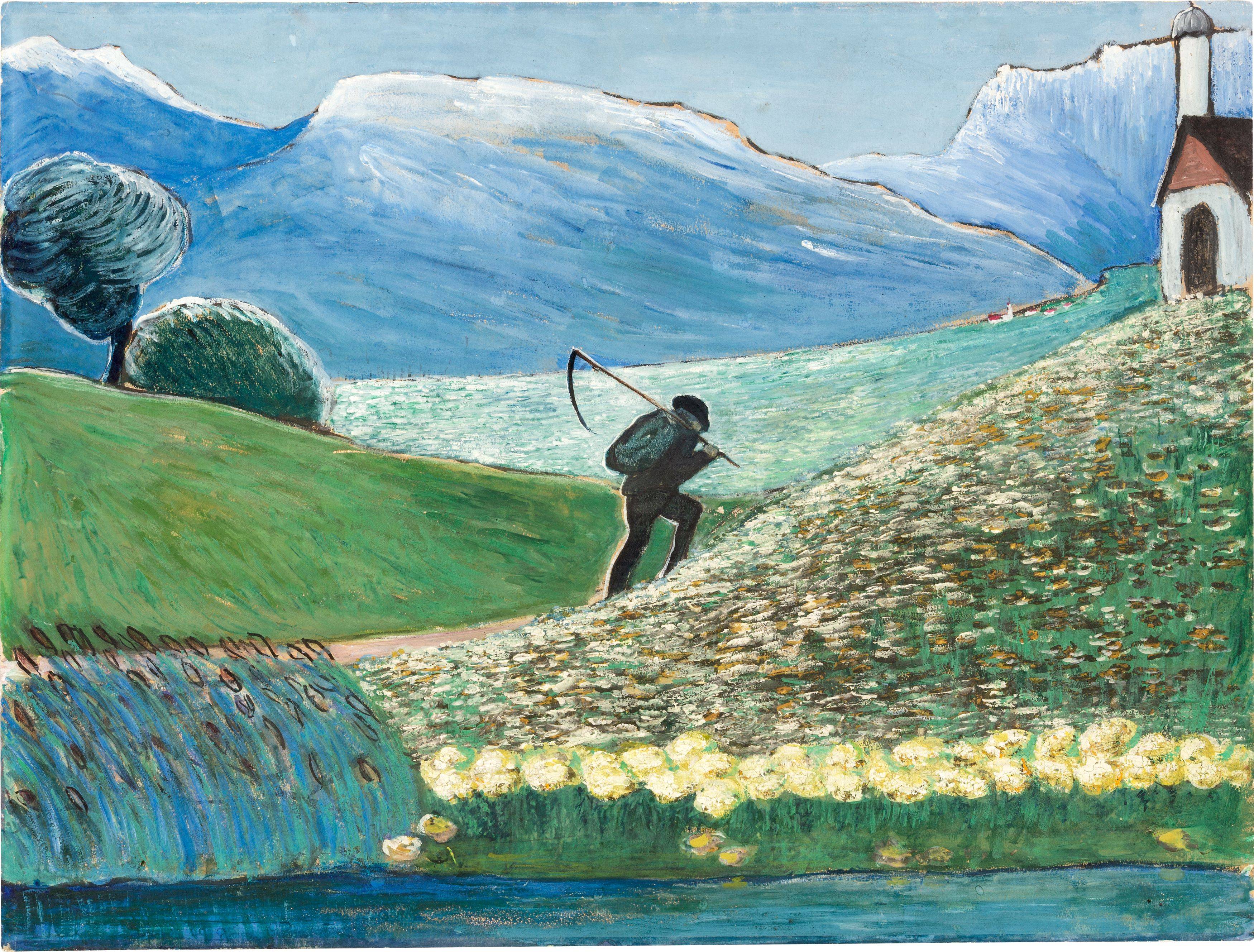
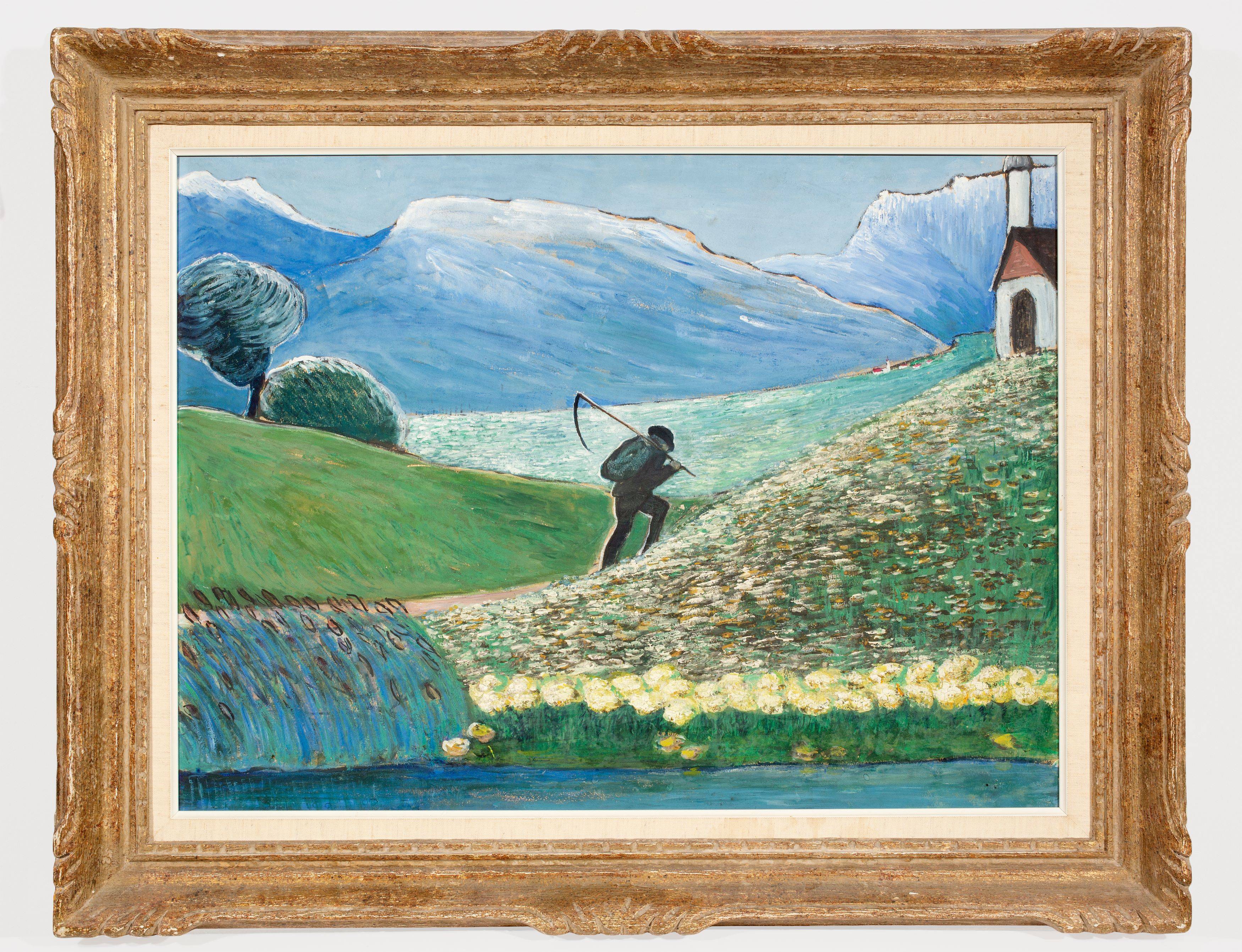
Bent forward, a scythe over his shoulder and a pack on his back, a reaper dressed entirely in black climbs the field path towards a hill. Marianne von Werefkin places the figure, condensed into a dark shadow, at the centre of the picture. A broad field of glowing yellow flowers and a meadow of rich green line the path, which leads him towards a chapel. In the background, a wide expanse shimmering green and white stretches out, bounded by a luminous blue mountain range set with white highlights. The colours of the mountains are applied so lightly that the brown ground shows through, itself becoming part of the painterly description of the range. Where the turquoise plain meets the mountains, the distant tower of a church suggests a settlement.
Werefkin seems to have assembled the individual elements and forms of the present tempera painting as in a collage: the tree, for instance, and the bush at the left edge, both of which are barely connected to their surroundings. On the contrary, Werefkin sets them apart from the landscape – as she does the reaper – with light outlines.
In its motif, Marianne von Werefkin’s painting belongs to the pictorial world of the landscape around Murnau. From 1908, this town in the Alpine foothills, some 70 kilometres south of Munich between the Staffelsee and Riegsee lakes, was one of the most important places of work for two artist couples: Marianne von Werefkin and Alexej von Jawlensky, and Gabriele Münter and Wassily Kandinsky. For each of them, and for the exchange between them, Murnau and the varied landscape surrounding the small town marked a decisive step in their artistic development in terms of composition and pictorial structure, choice of colour and brushwork. It was here that paintings were created that rank among the most important works of Expressionism. Gabriele Münter recorded how fundamental this exchange was to each artist’s development in her 1911 chronicle of their time together: “It was a beautiful, interesting, joyful period of work with many conversations about art [...]. All 4 of us strove hard and each one developed. [...] We were all industrious” (quoted in: Annegret Hoberg (ed.): Wassily Kandinsky und Gabriele Münter in Murnau und Kochel. 1902–1914. Briefe und Erinnerungen, Munich 1994, p. 46). Powerful areas of colour and strong contrasts now increasingly dominated Werefkin’s work.
While the shared time in Murnau found expression in numerous paintings, studies and sketches by Gabriele Münter, Wassily Kandinsky and Alexej von Jawlensky, Werefkin recorded the topography of the market town in the Alpine foothills mainly in countless sketchbooks. Unlike with the works of the other painters, specific places are difficult to identify with certainty. In Werefkin’s work, the concrete impression of nature is estranged and detached, becoming an overarching symbol. As regards the dating: Marianne von Werefkin spent the summer in Murnau for the last time in 1910. In style and motif, the present painting of the reaper is closely related to the 1909 painting “Kreuz in Landschaft” (Cross in Landscape), which can likewise be assigned to her stay in Murnau.
The period around 1910 is probably Werefkin’s most important creative phase, producing iconic major works such as her Self-Portrait (c. 1910, Städtische Galerie im Lenbachhaus, Munich) and “Der rote Baum” (The Red Tree, 1910, Fondazione Museo Marianne Werefkin, Ascona).
During this period, she repeated certain figures, pictorial elements and themes as a kind of typology. Among them are bent, walking figures (as in “Heimkehr” [Homecoming], c. 1908), rural labour (“Wäscherinnen” [Washerwomen], c. 1909; “Die schwarzen Frauen” [The Black Women], c. 1909; “Rhythmen” [Rhythms], 1910; or “Mann mit Schafherde” [Man with Flock of Sheep], c. 1910), the mountain landscape as a natural backdrop, and wanderers climbing up to a chapel, a motif she took up several more times until well into the 1920s.
The central figure of the painting, which gives it its title, is the reaper at the centre of the picture. This classic motif appears in the work of many renowned modern artists: from Pierre-Auguste Renoir (1873) and Georges Seurat (1881/82) to Albert Weisgerber (1902), Kazimir Malevich (1909), Ferdinand Hodler (c. 1910) and Karl Schmidt-Rottluff (in a woodcut of around 1910).
What might have attracted artists to this subject beyond their enthusiasm for everyday rural life and the people who worked the land? Ferdinand Hodler, who had taken up the motif of the mower while designing Swiss banknotes, was interested above all in the fluid, rhythmic sequence of movement.
Vincent van Gogh, on the other hand, who treated the subject several times, wrote in a letter to his brother Theo: “I see in this reaper a shadowy figure, a kind of devil struggling in the blazing heat to finish his work. I also see in it the image of death, in the sense that humanity is the wheat being mown down. So it is, if you like, the counterpart to the ‘Sower’ I attempted earlier. But there is nothing sad in this death; everything happens in full light, in a sun that floods everything with light and rich gold” (Vincent van Gogh to his brother Theo, Saint-Rémy-de-Provence, 5 and 6 September 1889, letter no. 800, quoted in: Vincent van Gogh. The Letters, URL: https://vangoghletters.org/vg/letters/let800/letter.html). With her black, stooping figure of the reaper – a grim reaper climbing the path to the chapel – Werefkin is clearly not exploring the movement of mowing; she too seems concerned with death and transience. The lighting underlines the painting’s dark, mystical mood, an atmosphere found in many of her works.
The links to Vincent van Gogh’s work are many-sided. His oeuvre resonates in the work of Werefkin’s companion Jawlensky, who in 1908 had managed to acquire a work by van Gogh for his private collection: “Van Gogh has been a teacher and a model to me,” Jawlensky wrote in thanks to the painter’s sister-in-law (quoted in: Walter Feilchenfeldt: “By Appointment Only”. Schriften zu Kunst und Kunsthandel. Cézanne und Van Gogh, Wädenswil 2005, pp. 64f.). Werefkin herself also referred to his influential work time and again, as in this passage from 1905: “I understand so well van Gogh’s idea of treating white and black as two colours and not as shadow opposed to light. He thought little of the colourists’ creed, for whom black is the absence and white the union of all colours. For van Gogh, white and black are values equal to the most luminous colours of his palette; they are two positive values” (quoted in: Marianne Werefkin: Briefe an einen Unbekannten 1901–1905, ed. Clemens Weiler, Cologne 1960, p. 45).
In motif and design, Werefkin responds to the Dutch painter’s work in a highly independent way. But her knowledge of the works of Edvard Munch, Paul Gauguin, the Nabis and the painters of Pont-Aven, which she studied closely during extended stays in France, also continues to resonate here. This affinity with France earned her the nickname “the Frenchwoman” among her circle of friends in Munich.
Marianne von Werefkin’s painting “Der Schnitter” ultimately became one of the most important works with which the painter wrote herself into the early history of the Blue Rider. In January 1909, the Neue Künstlervereinigung München (New Artists’ Association Munich) was founded, largely prepared in Marianne von Werefkin’s salon on Giselastraße in Munich-Schwabing. Wladimir von Bechtejeff, Alexej von Jawlensky, Wassily Kandinsky and Marianne von Werefkin were among the first members of the group, which Erma Bossi, Karl Hofer and Moissey Kogan also joined that same year. “We proceed from the idea that, apart from the impressions he receives from the external world, from nature, the artist is continually gathering experiences in an inner world,” declared the group’s founding manifesto, to which Marianne von Werefkin, born in Tula, Russia, in 1860, also felt committed. From December 1909 to December 1911, the avant-garde artists of the Neue Künstlervereinigung presented their work in three epoch-making exhibitions.
In 1912, the art historian Otto Fischer published the bibliophile book “Das Neue Bild” (The New Picture), a lavish presentation of the Munich artists’ work in text and on 36 plates. In it, he wrote of Marianne von Werefkin: “For this spirited woman, art is the most indispensable expression of an inner life [...]. She is always concerned with what is quite particular, gripping and oppressive in a mood, which she seeks to make suggestive. She grasps and feels things from within, in their strangeness” (Otto Fischer: Das Neue Bild. Veröffentlichung der Neuen Künstlervereinigung München, Munich 1912, pp. 42f.). Several exemplary works by Werefkin bear out Fischer’s words, the present painting “Der Schnitter” among them.
Werefkin, however, reacted to the publication with great indignation: “The book struck me like the lash of a whip,” she wrote (quoted in: Bernd Fäthke: Marianne Werefkin: Leben und Werk, 1860–1938, Munich 1988, p. 127). The painter had voiced her doubts even before Fischer was commissioned, since, as she complained, he “faced the art of most members with complete incomprehension” (ibid.). The dispute over “the spiritual in art” ultimately accompanied the shift from the Neue Künstlervereinigung München to the exhibition association “Der Blaue Reiter” (The Blue Rider). In December 1911, Kandinsky, Münter and Franz Marc had left the Neue Künstlervereinigung to come together as the editorial board of the almanac “Der Blaue Reiter”. From 1912, Jawlensky and Werefkin also exhibited with this more progressive group, which had committed itself to the adventure of Expressionism and non-objective art.
Marianne Werefkin kept her iconic painting “Der Schnitter”, which marks her transition from the Neue Künstlervereinigung to the Blue Rider, in her own collection for the rest of her life. After decades in private ownership, it now returns to the art market. It offers the opportunity to acquire a museum-quality major work by the “Blue Rider’s horsewoman” (Blaue Reiter-Reiterin), as the poet Else Lasker-Schüler called the painter in 1913. Gloria Köpnick
Subject to change - Please refer to our conditions of sale.