
Lot
2
Opočno 1871 – 1957 Puteaux
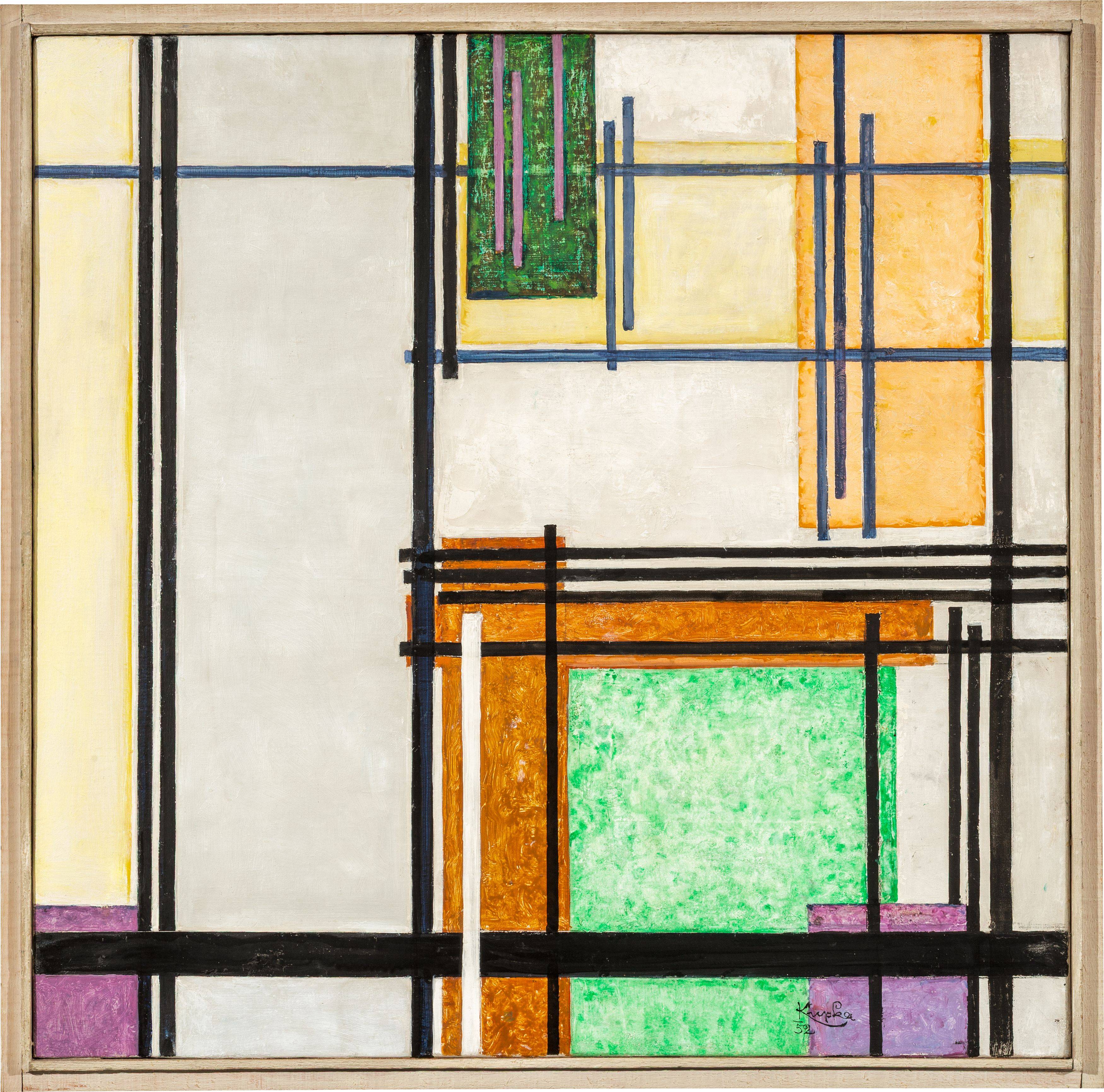
”Vibrantes” (”Vibrující”). 1952

Background:

Background:


Background:


Background:

Background:
Estimate:
EUR 150,000
- 200,000
USD 169,000
- 225,000
Auction 378
Thursday, 26.11.2026, 6:00 PM
Request condition report
Ask our specialists
Eugénie Kupka, Paris (until at least 1968) / Carl Laszlo, Basel / Private Collection, Berlin (presumably acquired 1971 from Carl Laszlo, Basel)
VIII Salon des réalités nouvelles: Jubilé Kupka. Paris, Musée des Beaux-Arts de la Ville de Paris, 1953
The World of Vibrations – How František Kupka Made Form and Colour Resonate
Was there actually anything he couldn’t do? That’s the question one sometimes finds oneself asking about the Czech modernist František Kupka, that pioneer of abstraction. A rhetorical question, for Kupka could do everything. He absorbed the whole world, including the world of painterly styles, and then distilled it into art. He painted with translucent dabs like the Impressionists, in a modern realist style like Lovis Corinth, and drew with a loose, playful touch like Toulouse-Lautrec. He turned to Symbolism à la Klimt, conceiving his art in an esoteric, cosmic manner like Hilma af Klint, or later in a sober, geometric style like Mondrian.
Above all, however, Kupka knew how to be entirely himself. The 1952 painting ‘Vibrantes’ illustrates this perfectly. Like so many of his late works, it refers back to an earlier piece – in this case, a gouache from 1922. By then, Kupka, originally from the Bohemian countryside, had already conquered the European art world in Paris. With an open-minded diversity of styles. With a determined drive towards abstraction that propelled modernism forward. With an outsider’s perspective at the very heart of the avant-garde. And also with the softness, the shimmer of his personality, which set all forms – even the more strictly geometric ones – in vibration. He himself linked his work to music, for example in the painting ‘Les Touches de piano. Le Lac’ from 1909, which marks the transition from the realistic-symbolic to the abstract. Kupka’s entire oeuvre seems to effortlessly unite the lyrical flow of Smetana’s ‘Vltava’ and the rhythmically modern elemental force of Stravinsky’s ‘Sacre du Printemps’.
Born on 23 September 1871 in Opočno, East Bohemia, Kupka received his artistic training at the academies in Prague (1889–1892) and Vienna (from 1892), where he engaged intensively with theosophical and scientific writings. In the spring of 1896, he moved to Paris, earning his living as a book illustrator and caricaturist. In 1906, Kupka moved to the Parisian suburb of Puteaux. He became a close associate of the brothers Jacques Villon, Raymond Duchamp-Villon and Marcel Duchamp, as well as Robert Delaunay, Fernand Léger and Francis Picabia. At the 1912 Autumn Salon, Kupka exhibited his groundbreaking paintings ‘Amorpha – Fugue à deux couleurs’ and ‘Amorpha – Chromatique chaude’. He summarised his thoughts on this new, non-representational style of painting in 1913 in the essay ‘Die Schöpfung in der bildenden Kunst’, which, however, was not published until ten years later.
From 1919 onwards, his most important early patron and principal collector was the Prague industrialist Jindřich Waldes. In 1921, the Galerie Povolozky in Paris staged Kupka’s first solo exhibition. In 1931, he was one of the founding members of the artists’ association Abstraction-Création, alongside Hans Arp, Albert Gleizes, Jean Hélion and Auguste Herbin, amongst others. A milestone in his international reception came in 1936 when Alfred H. Barr Jr. established Kupka as a pioneer of non-representational art in the groundbreaking exhibition ‘Cubism and Abstract Art’ at the Museum of Modern Art in New York. After 1945, the artist increasingly withdrew to his studio in Puteaux and transformed his early designs into a radical geometric late phase. He nevertheless remained in the public eye: until the end of his life, he exhibited regularly at the Salon des réalités nouvelles, the central forum for abstract art in post-war Paris. Kupka died on 24 June 1957 in Puteaux. The very following year, the Musée national d’art moderne in Paris honoured him with a retrospective.
With the painting ‘Vibrantes’, completed in 1952 in his studio in Puteaux, František Kupka reached the quintessence of his late work. During his years of seclusion, this pioneer of non-representational painting formulated a synthesis of the theories of space and colour he had developed throughout his life. In Ludmila Vachtová’s monograph, published eleven years after Kupka’s death, there is a statement by the artist that reads like a self-description of his late style: ‘a kind of painterly geometry of thought’. Although the statement is not precisely dated, with Kupka everything is interconnected anyway. Not only do the roots of the pictorial concept behind ‘Vibrantes’ stretch far back into Kupka’s early pioneering days; throughout his life, the artist also aimed to capture the entire cosmos in his painting. John Russell, an art critic for the New York Times, observed this in 1975 on the occasion of the first major US retrospective at the Guggenheim in New York: ‘Kupka tried to get the whole history of the universe into his paintings.’ For Kupka, however, it was not a matter of translating the movement of the external world into the picture, as he believed the Futurists, for example, were attempting to do. Rather, his aim was to invent a movement of the image itself. In a letter to his friend, the Viennese art critic Arthur Roessler, Kupka wrote as early as 1913: ‘We must start completely afresh. […] When we draw a line or place a dot, it should sit so appropriately in space that one has the impression it is an event […] The same applies to colour.’
It is precisely this ‘event’ of form and colour that is masterfully evoked in Kupka’s ‘Vibrantes’. Whilst ‘Fugue’, painted almost exactly forty years earlier, creates a sense of swirling motion, the later painting plays with vibrations. The impasto-like, chalky, nuanced white ground and the angular, clear yet freehand-drawn black bars and colour fields create a vibration that gives the work its programmatic title. Here, where lines and cloud-like, dabbed areas meet, the cosmos of Kupka’s art emerges. In his younger years, he had been influenced by ideas relating to lifestyle reform and theosophy, for instance within the Viennese circle of Karl Wilhelm Diefenbach. This is still clearly evident in ‘Plans par couleurs, grand nu’ and in his breakthrough works ‘Amorpha – Fugue à deux couleurs’ and ‘Amorpha – Chromatique chaude’. On the basis of these paintings, Guillaume Apollinaire classified him as an Orphist – a new movement within the avant-garde proclaimed by Apollinaire himself, which broke away from the analytical Cubism of Picasso and Braque. Yet even then, this seemed too simplistic to Kupka; he always wanted to go his own way.
In his later work, one senses a sober metaphysics rather than esotericism. Kupka had long recognised higher laws not only in energetic vibrations and the cosmic, but also in the mathematical and geometric organisation of space. Quite specifically, for instance, in Gothic cathedrals and ancient Greek temples. He wrote, again to his friend Roessler, just one year after his breakthrough: “Contemplate the Doric, indeed even the Ionic temples, and your pulse quickens rhythmically, lifting you into an elevated, solemn mood.”
Before Kupka’s late masterpiece ‘Vibrantes’, all viewers may experience something similarly stimulating as they immerse themselves in the subtleties of this late-modern painting. The mood of the Czech collector Meda Mládková must have been no less solemn when she met Kupka in Paris in 1956. Mládková was so moved by this artist that, by the time of her death in 2022, she had amassed more than 200 of his works – now housed and exhibited at the Kampa Museum in Prague. Simon Elson
Subject to change - Please refer to our conditions of sale.