Lot
47
Vienna 1928 – 2000 at sea en route to Australia
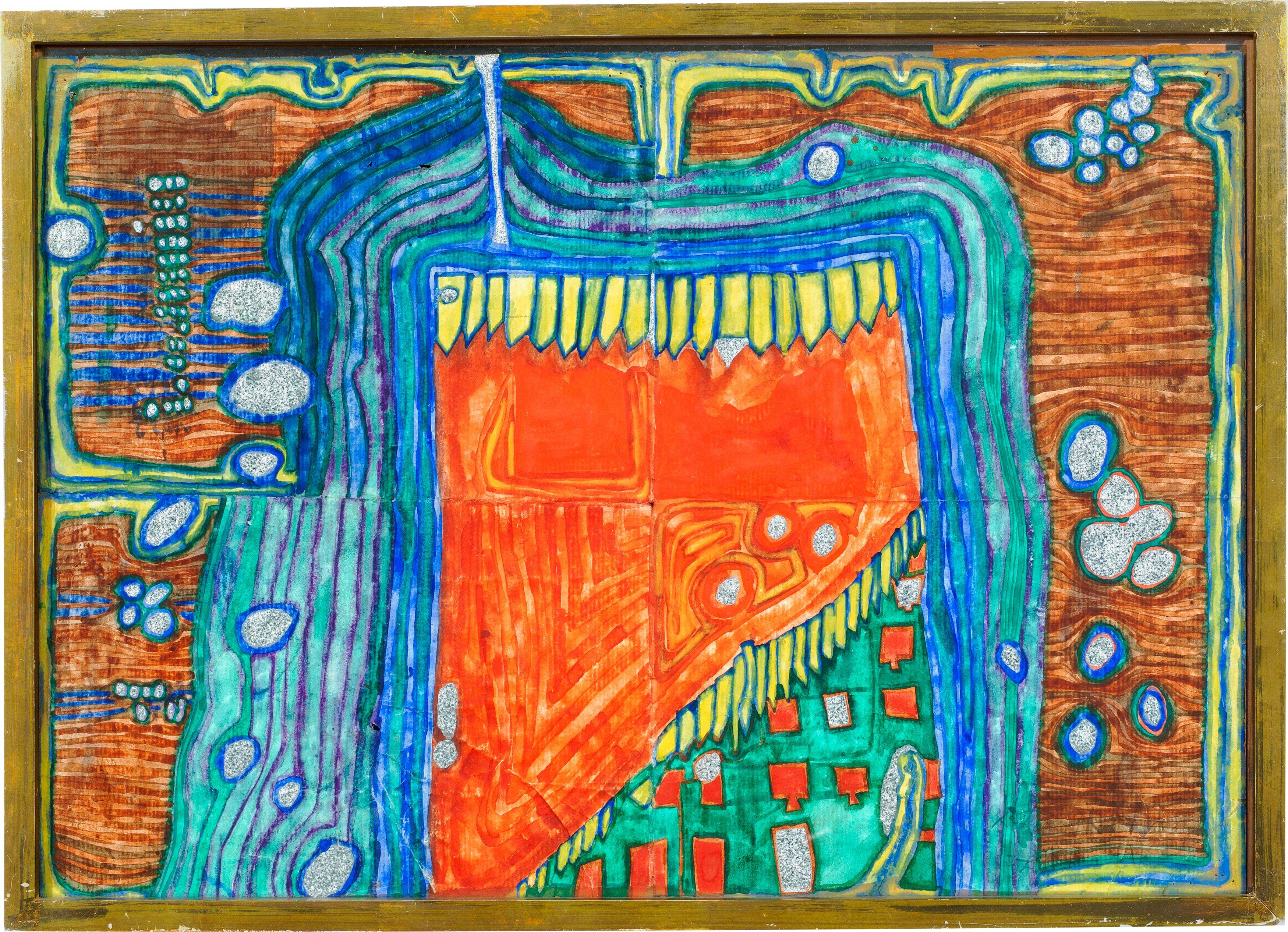
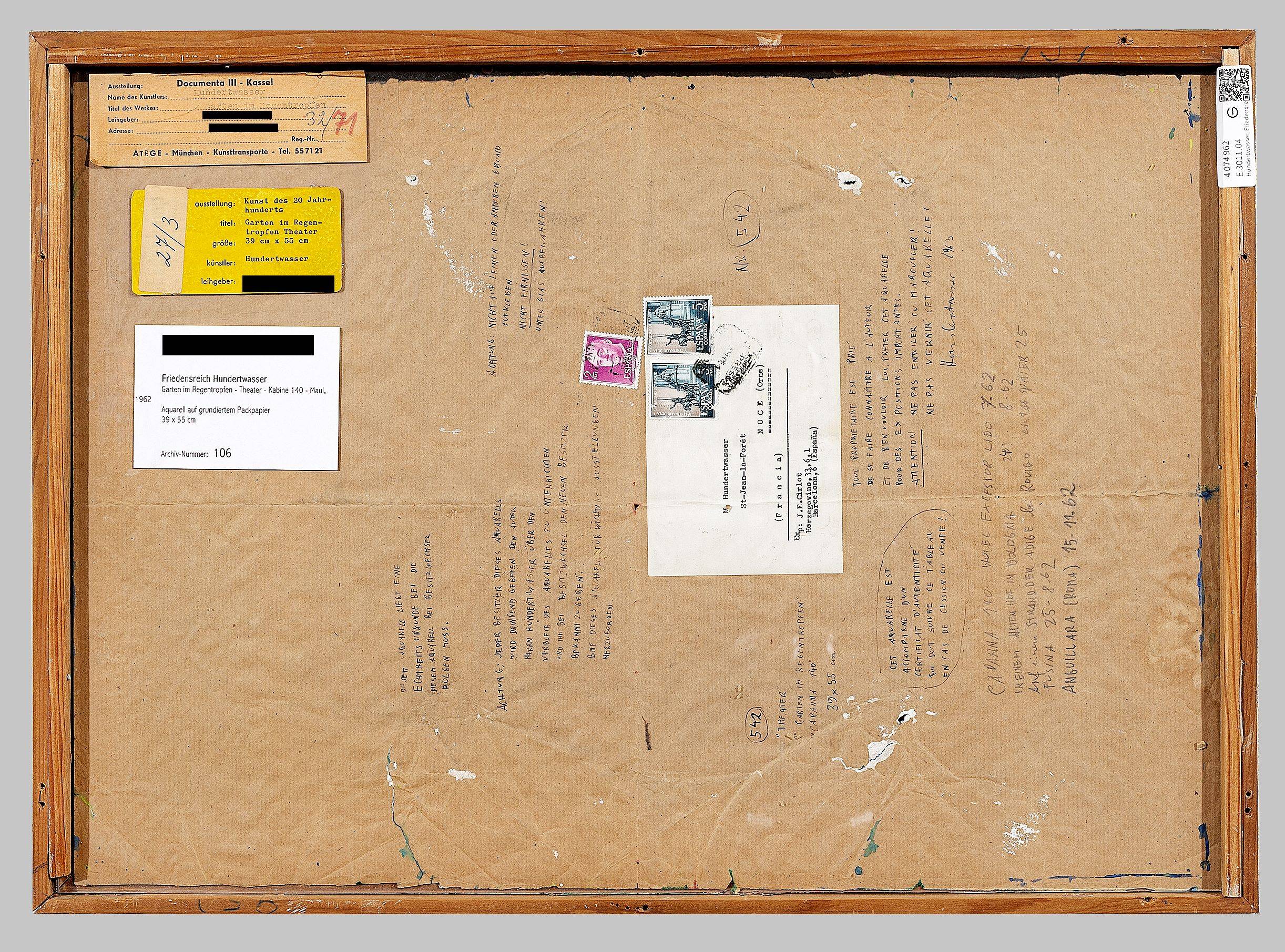
”Garten im Regentropfen – Theater – Maul – Capanna 140”. 1962

Background:

Background:


Background:

Background:
Estimate:
EUR 100,000
- 150,000
USD 112,000
- 169,000
Auction 378
Thursday, 26.11.2026, 6:00 PM
Request condition report
Ask our specialists
1964 publizierte the Buchheim-Verlag in Feldafing of this watercolour a postcard.
Private Collection, Berlin (acquired in the 1960s at the Galerie Aenne Abels, Cologne)
Hundertwasser – Prima mostra personale a Roma. Rome, Galleria Medusa, 1962 / Hundertwasser ist ein Geschenk für Deutschland. Cologne, Galerie Aenne Abels, 1963, ill. pl. 23 / documenta III. Kassel, Kabinette im Museum Friedericianum, 1964, Hundertwasser-cat. no. 4, p. 142 / Hundertwasser. Hanover, Kestner-Gesellschaft, 1964, p. 203, ill. p. 99 / Du und Dein Paradiesgarten. Paradiesgartenmotive der Künstler L. Cranach and F. Hundertwasser. Wittenberg, Cranach Stiftung, 2006 / Friedensreich Hundertwasser. Gegen den Strich, Werke 1949–1970. Bremen, Kunsthalle, 2012/13, p. 212/13
Wieland Schmied: Hundertwasser. Feldafing, Buchheim Verlag, 1964, p. 29 and 45 / Regentag-Wassergläser für das Leben. Vienna, 2011, p. 48/49 (English Ausgabe) / Sepp Wille: Träume sind große Taten. Freiburg, Basel, Vienna, Herder, 1993, p. 33
Against the Ruler: Friedensreich Hundertwasser's "Garten im Regentropfen – Theater – Maul – Capanna 140"
In the work of Friedensreich Hundertwasser, playfulness and seriousness merge on an equal footing. The early watercolour "Garten im Regentropfen – Theater – Maul – Capanna 140" (Garden in the Raindrop – Theatre – Mouth – Capanna 140) bears witness to this, and also to the unbroken creative drive that made the Austrian artist always carry a sheet of paper, folded as small as possible, and a box of watercolours in his coat pockets, so that he could use every spare minute on the move to paint.
As in the Surrealist game of "cadavre exquis", Hundertwasser describes this process of the individual folded sections, which he eventually joins together: "In this picture you can see quite clearly that I painted four separate parts independently of one another. In doing so, I do strive for the whole to become a unity – that is to say, when I paint one part, I imagine what has already been created on the other, and try to continue it."
In the autumn of 1962 in Venice, where he had the Austrian Pavilion at the Biennale to himself, the medium-sized "Garten im Regentropfen – Theater – Maul – Capanna 140" prompted many associations and readings. These are reflected in the title and already anticipate the major themes of Hundertwasser's later work: nature, architecture and their interplay with human life. Executed in the style of glowing colours and winding lines that Hundertwasser found early on, the depiction of the little hut can also be read as a mouth with sharp teeth or as a theatre stage whose garish red curtain is about to rise. Characteristic elements such as drops and borders are not merely decorative accessories here, but become independent components of the work.
This brings to mind the tradition of horror vacui, but also shows the influence of artists such as Gustav Klimt and Paul Klee on Hundertwasser's formal language, with which he declared war on "the ruler" and on cool reduction of the kind Adolf Loos had advocated in "Ornament and Crime" (1913). This rejection of hard, geometric form was probably also due to its association with military order, with marching in rectangles. It remained a horror all his life to Hundertwasser, who was born in Vienna in 1928 of Jewish descent and, forcibly resettled by the National Socialists, was one of only a few members of his family to survive the Shoah.
When the watercolour was exhibited at documenta III in Kassel in 1964, two years after it was made, Hundertwasser was well on the way to becoming not only the most famous but also the most controversial artist in Austria, as the critic Pierre Restany would later put it. For alongside his anti-fascist stance, Hundertwasser attracted attention as an ecological pioneer. His ideas of green façades and liveable living spaces with many windows are more relevant today than ever. It is hardly surprising, then, that the Kunst Haus Wien, which he designed, is now home to the Vienna Climate Biennale. Although Hundertwasser's architectural designs are now world-famous and his formal language has long since entered popular culture, his work is at its core a painterly one, as "Garten im Regentropfen – Theater – Maul – Capanna 140" exemplifies. Kathrin Heinrich
Subject to change - Please refer to our conditions of sale.