
Lot
35
Limoges 1841 – 1919 Cagnes-sur-Mer
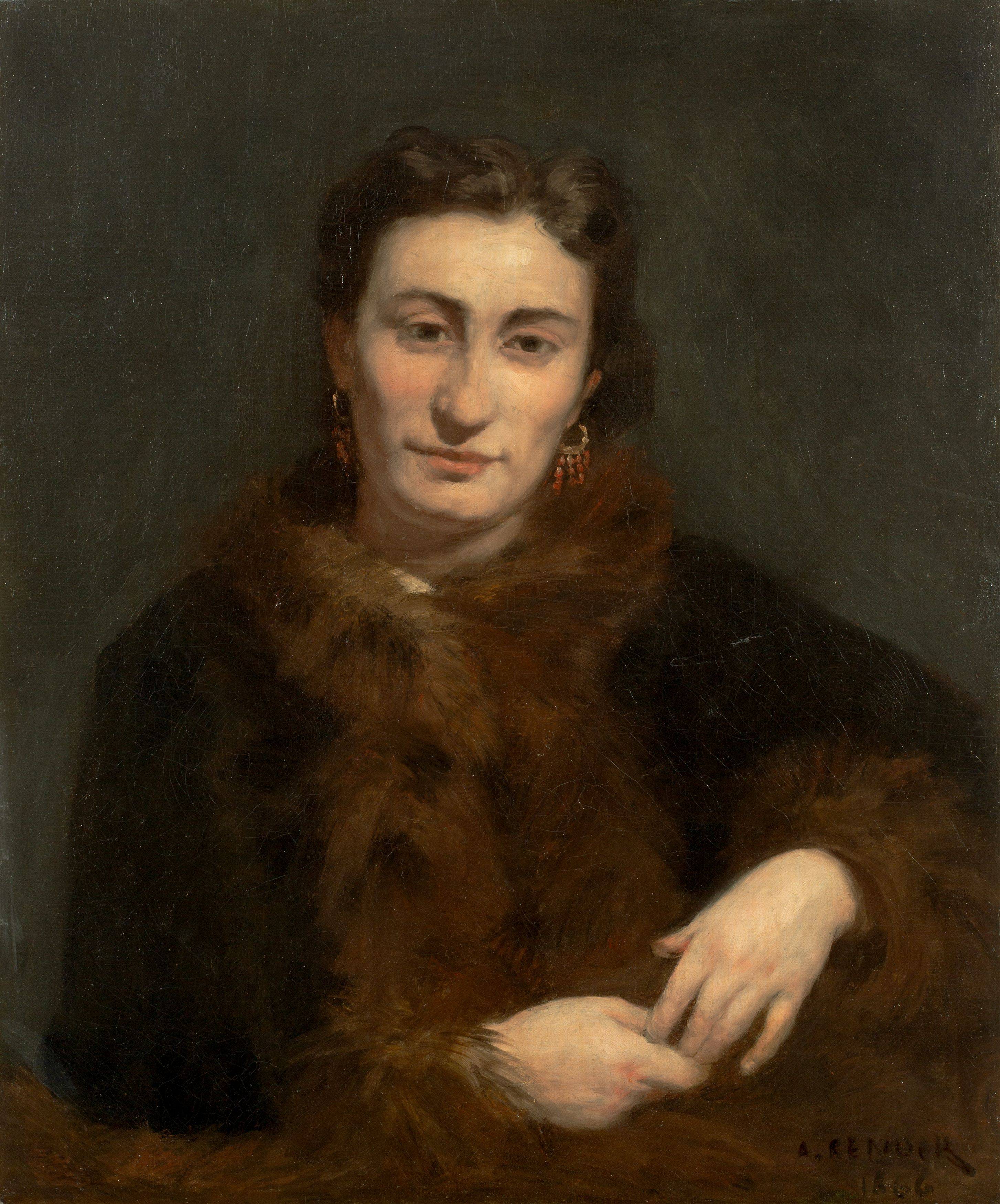
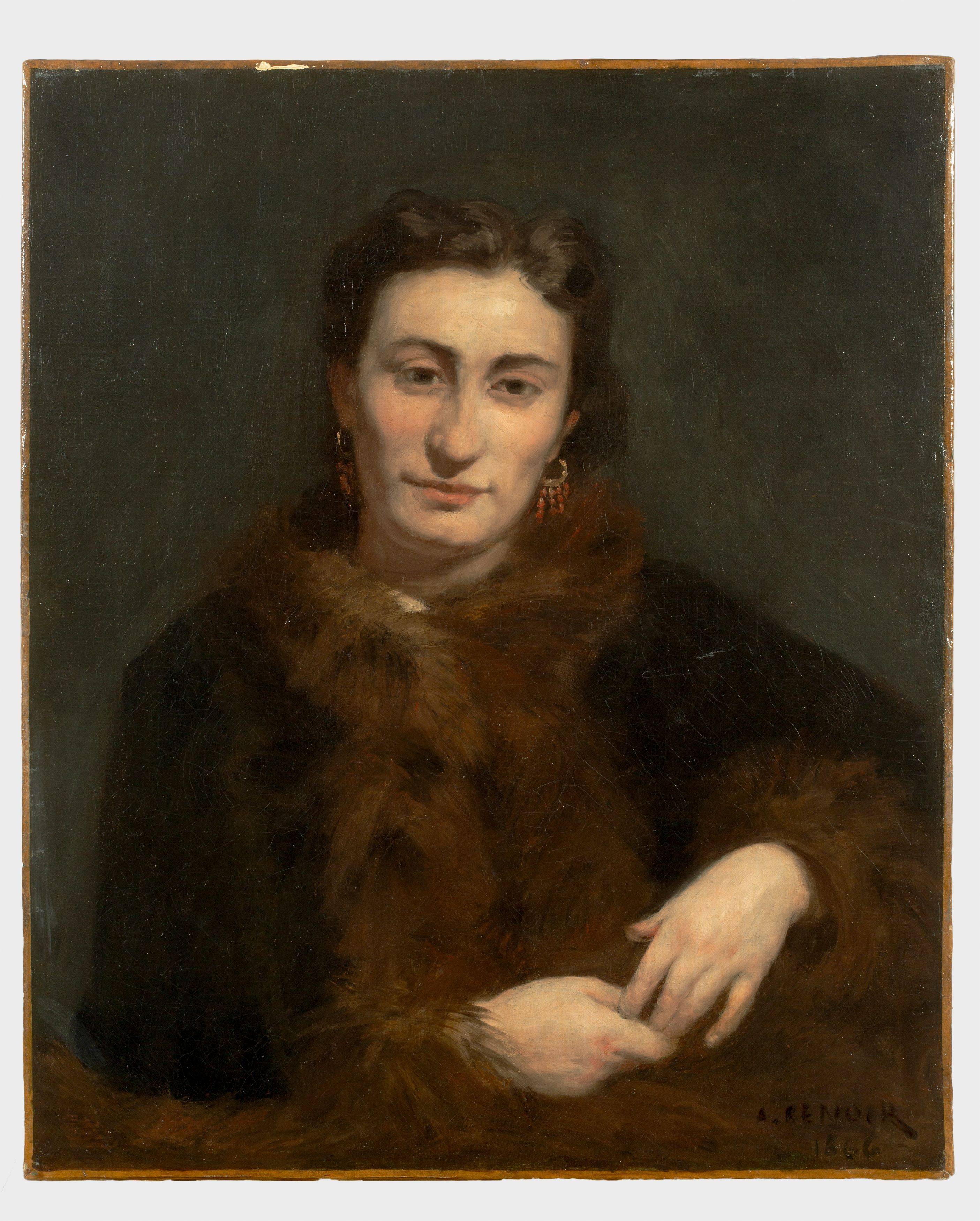
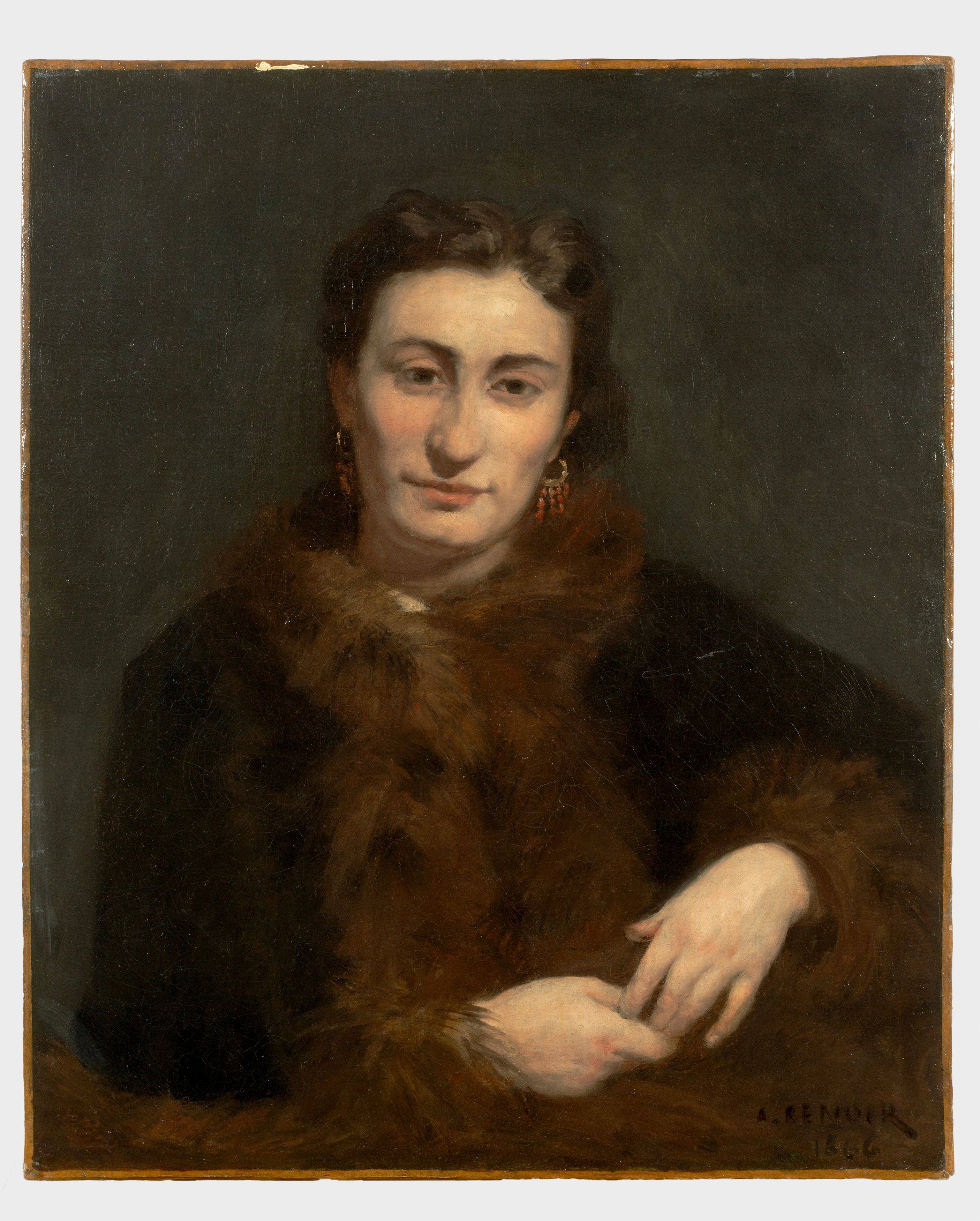
”Portrait de femme à la fourrure”. 1866

Background:

Background:

Background:

Background:

Background:
Estimate:
EUR 200,000
- 300,000
USD 225,000
- 337,000
Auction 378
Thursday, 26.11.2026, 6:00 PM
Request condition report
Ask our specialists
The painting will presented in the original to the Wildenstein Plattner Institute, New York/ Paris in December 2026 in their committee meeting regarding the new edition of the catalogue raisonné of paintings by Auguste Renoir .
Prince Alexandre de Wagram, Paris / Galerie Barbazanges, Paris / Lucas Lichtenhan, Basel / Arthur Zivy, Basel / Rolf Deyhle, Stuttgart (until 2012) / Private Collection, Baden-Wuerttemberg (since 2012, 2006–2026 as long-term loan in the Staatsgalerie Stuttgart)
Renoir zwischen Bohème und Bourgeoisie: die frühen Jahre. Basel, Kunstmuseum, 2012, cat. no. 5, ill. / Renoir Intimidad. Madrid, Thyssen-Bornemisza and Bilbao, Museo de Bellas Artes, 2016/17, cat. no. 1, ill. p. 80 („Señora con abrigo de piel“)
François Daulte: Auguste Renoir. Catalogue raisonné de l’œuvre peint. Tome I: Figures 1860-1890. Lausanne, Editions Durand-Ruel, 1971, cat. no. 17, ill. / Udo Felbinger: Renoir avant Renoir: Die Dame in the Pelz, 2019 (online)
Auguste Renoir and the Mystery of the Lady in Fur
Who was Renoir? Or rather: how did a young artist from Limoges who started out as a porcelain painter become Renoir? World-famous in his own lifetime, he remains by far one of the most popular and best-loved of the French Impressionists. He was close friends with them from the start, though he did not necessarily count his own painting among theirs. He was revered in the highest degree by all his important fellow artists, up to and including Cézanne and Matisse. What role did his formative years play for this "greatest painter of his time" (Apollinaire, 1913)?
Important writers, critics and art historians have always concerned themselves with this question. In an insightful essay, Michael F. Zimmermann examined the different views, each rooted in its own time, which nonetheless agree on one thing to this day: a great fascination with this artist. The essay appeared in the catalogue of the groundbreaking exhibition on Renoir's early work initiated by Nina Zimmer at the Kunstmuseum Basel in 2012. The "Portrait de femme à la fourrure" (Portrait of a Woman in Fur) was also shown there, on loan from the Staatsgalerie Stuttgart. It is a significant work, because in old age Renoir, like many of his great colleagues, helped shape his own myth by probably destroying a whole series of early paintings and works on paper that were still in his possession. The "Portrait de femme à la fourrure" escaped this fate.
She sits unusually close to us, almost as if she would walk straight towards us if she stood up. Yet there is no doubt: this is about painting. She does not seem to feel any need to present herself in a special way, and the young painter surely did not want it otherwise, despite the formal format he chose for her portrait. He lets her sit in peace, and she lets him paint in peace. Who she is, we still do not know today. It is possible that we never will.
The portrait shows a middle-aged woman with experience of life, neither young nor old. Dressed in dark clothing against an almost black-green ground, the pale flesh tones of her face and hands stand out all the more clearly. Her head is tilted, only very slightly, towards her left shoulder, so that her right earring nestles against her neck while the left one hangs free. The gold hoop earrings with coral pendants are her only jewellery; she wears no rings either, except perhaps a wedding ring that is not visible. Her left arm rests relaxed on the arm of a chair or the edge of a table, which we also do not see. Her right arm is bent at lap height, her right hand gently enclosing the tips of the three middle fingers of her left hand, which hangs casually from the end of the armrest. Her dark, slightly wavy hair is loosely tied back. She wears a "fur-trimmed paletot, probably of black velvet", according to Udo Felbinger (Udo Felbinger: Renoir avant Renoir: Die Dame im Pelz, 2019 [online]). Today this would be a classic men's coat. Originally a simple garment of the working population, at that time it developed, at least among men, into the fashionable substitute uniform of the modern professional man and of the bohème (the dandy's coat). In women's fashion it corresponded to a jacket of a good half to three-quarter length, worn casually over the voluminous skirt.
We know this garment from Claude Monet's portrait of his wife, "Camille in the Green Dress", as famous as it is ravishing, which is held by the Kunsthalle Bremen. Monet, already a close friend of Renoir's at the time, exhibited it at the Paris Salon in the same year, 1866. We shall return to this. Felbinger notes, in any case, that this "comparatively simple but costly garment" is unusual for women's portraits of the period, since "the models usually wear silk and cotton dresses and not street clothes" (ibid.).
Quite a few things are "unusual" about this picture. Far removed from the classical or charming exaltation and idealisation that the taste of the time clearly favoured (the annual Salon was hung full of such portraits, since they promised lucrative commissions), we look into an extremely lifelike face. The high cheekbones may hint at the sitter's beauty in her youth. The painter by no means conceals the traces of age in her skin, the slightly slackened features, the not quite straight nose and the chin, slightly doubled in shadow. Quite the contrary: it is precisely here that he concentrates on the painterly rendering. Above all, the sitter seems to be enjoying the moment of rest, the interruption of her perhaps busy daily life during this sitting. A gentle smile, benevolent and a little tired, plays around the corners of her mouth. Heavy lids frame her beautiful dark eyes, slightly shadowed, of which the right is a little more closed than the left (the lower lid seems almost slightly swollen). Her slightly lowered gaze is directed outwards as much as inwards. Lost in thought, she is perhaps pondering the tasks of the day, or simply daydreaming, seeking a moment of stillness within herself.
Auguste Renoir was 25 years old when he created this work in 1866. "It is the time of Courbet's influence. None of the Impressionists showed this influence more clearly than Renoir at the beginning of his career. Two kindred spirits seem to meet, and they retain much in common later on," wrote Julius Meier-Graefe, who published his Renoir monograph in 1911, while the artist was still alive. For him, the 1860s and 1870s were clearly the most interesting: "The high painterly qualities do not conceal the primitive nature of the impression. The power is so convincing because it uses no hidden paths" (Meier-Graefe 1911, pp. 6f.). Besides the brown-toned palette and the choice of a model from outside high society, the generous, broad brushwork is comparable, although Renoir clearly strips it of the drama and exuberant force of his rebellious model. However different their temperaments and the "views they give pictorial form to" (ibid., p. 10), the two artists clearly meet in the sensual immediacy of their painting. Interestingly, this even includes details such as faces that appear slightly distorted when seen close up (cf. among others Gustave Courbet: "Les Demoiselles des bords de la Seine", 1856; Zimmermann 2012, p. 21). At the same time, the soft application of paint, the gentler transitions and the smoothed painting remain characteristic of Renoir's later work too: "Similarity of means does not entail sameness of result. The sensibilities of the two artists, so different in essence, could only ever go together for very short stretches," as Meier-Graefe put it (ibid.). Indeed, Renoir's artistic engagement with Courbet was limited to the years 1864 to 1866. It is therefore of great value that the "Lady in Fur" has survived.
Two further important aspects connected with this picture should at least be mentioned. The first is the evident engagement with the Old Masters. Renoir was a regular museum-goer and spent a great deal of time in the Louvre. "When I say that one learns to paint in the Louvre," Renoir himself remarked, "I do not mean that one should imitate the Old Masters there […]. One must make the painting of one's own time" (quoted in: Götz Adriani: Renoir, 1996, note 26). This too is exemplified in the "Lady in Fur", which is clearly "painting of its time" while hardly disguising its Old Master models.
The second is that this work takes us right into the Paris studios and workrooms of a handful of young artists who would later achieve world fame as Impressionists. Renoir had met Claude Monet and Frédéric Bazille as fellow students in the class of Charles Gleyre at the Paris Academy of Art. They became friends; Monet and Renoir painted together in the Forest of Fontainebleau and were enthusiastic about the Barbizon painters there and about Courbet. At the time, both lived lives marked by worry and serious hardship. "Renoir experienced the social conditions of his time in all their harshness, without reflecting on them in his art" (Adriani 1996, p. 19). In 1865/66 the painting he submitted to the Paris Salon had once again been rejected: a "Landscape with Two Figures", of which only one figure survives, as a fragment.
We know this painting, however, from a very famous picture by his wealthy artist friend Bazille. In Bazille's large-format painting of his studio at 9 rue de la Condamine (Renoir lived here with his close friend from 1868 to 1870 because he could not afford a room of his own), it hangs prominently on the end wall to the right of the window, above a still life by Monet. After the rejection of his painting, Renoir painted the now very well-known picture of the artistic bohème in Marlotte, a poor village near Barbizon, which also draws heavily on Courbet (cf. Renoir: "At the Inn of Mother Anthony", 1866, Nationalmuseum, Stockholm; Courbet: "After Dinner at Ornans", Musée des Beaux-Arts, Lille; among others Zimmermann 2012, p. 32).
That same year, 1866, his friend Monet had his first success at the Paris Salon with the full-length portrait of his companion, "Camille in the Green Dress". Monet and Bazille were not the only ones to work increasingly on large-format portraits that year: Auguste Renoir joined them. The "Lady in Fur" takes us right into this early period that the young Impressionists shared in Paris. She will probably keep the mystery of her identity forever. But she was there; she knew him, the young Renoir. And so her portrait remains a precious part of the mystery surrounding the enchanting myth of how Renoir became Renoir. Anna Ahrens
Subject to change - Please refer to our conditions of sale.