Lot
55
Dresden 1876 – 1907 Worpswede
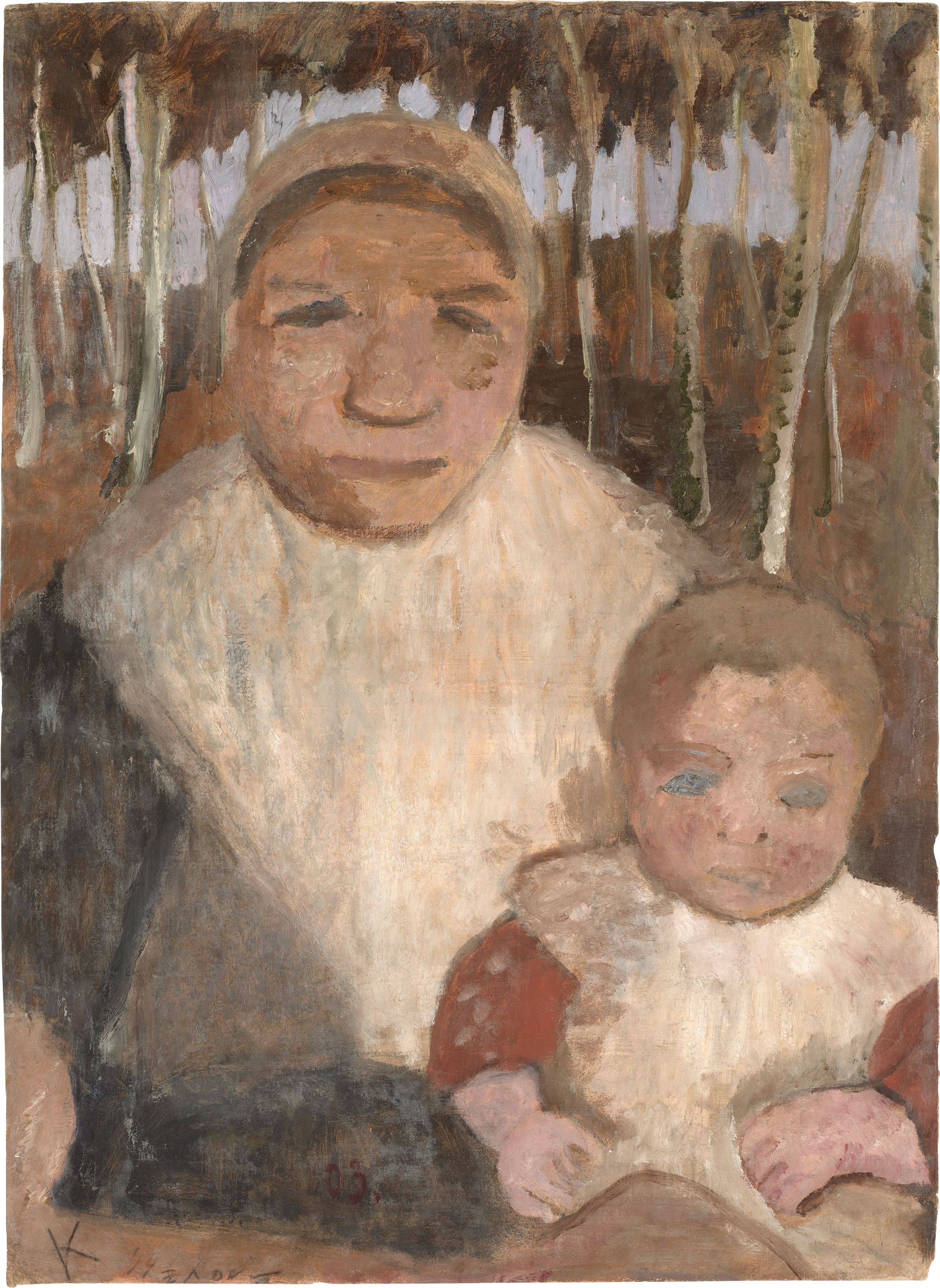
”Sitzende Bäuerin mit Kind vor Birken”. 1903

Background:

Background:


Background:

Estimate:
EUR 150,000
- 200,000
USD 169,000
- 225,000
Auction 378
Thursday, 26.11.2026, 6:00 PM
Request condition report
Ask our specialists
Christian Bruhn, Reinbek near Hamburg (1917) / Max Bruhn, Reinbek near Hamburg (1939) / Private Collection, Southern Germany (1961-1974 as long-term loan in the Kunsthalle Bremen)
Ausstellung von Werken neuerer Kunst aus Hamburger Privatbesitz. Hamburg, Kunsthalle, 1917, cat. no. 70 / Paula Modersohn-Becker 1876-1907. Gemälde, Zeichnungen, Radierungen. Bremen/Berlin, Kunsthandel Wolfgang Werner, 2014/15, cat. no. 13, ill. / Paula Modersohn-Becker 1876-1907. Gemälde, großformatige Zeichnungen, Kompositionsstudien. Bremen/Berlin, Kunsthandel Wolfgang Werner, 2019/20, cat. no. 10, w. ill.
Gustav Pauli: Paula Modersohn-Becker (=Das Neue Bild. Bücher für die Kunst der Gegenwart, vol. 1). Leipzig, Kurt Wolff Verlag, 1919, no. 251
At the beginning of 1903, Paula Modersohn-Becker travelled from Worpswede to Paris for the second time. It became another formative period of study for her, strengthening her in her search for the "great simplicity of form", as she noted in her diary (entry of 25 February 1903, quoted in: Günter Busch, Liselotte von Reinken (eds.): Paula Modersohn-Becker in Briefen und Tagebüchern, Frankfurt am Main 2007, p. 410).
Back in Worpswede, she noted in her diary in April of that year: "I am getting close to our people here again, I feel their great biblical simplicity" (ibid., p. 430), and she once more began to portray the inhabitants of the poorhouse, old and young people, and again and again mothers with their babies. In the present painting, "Sitzende Bäuerin mit Kind vor Birken" (Seated Peasant Woman with Child in Front of Birches), she likewise sets her figures into the typical landscape of Worpswede. The group of the peasant woman and child fills almost the entire pictorial space. In keeping with the "great simplicity of form" she had spoken of, their facial features, hands and clothing are condensed to the utmost and abstracted from the individual. The background is formed by the structuring rhythm of the birch trunks, a typical motif in her works of this period. Again and again, blue sky flashes through the slender trunks.
The present museum-quality painting makes clear what Otto Modersohn remarked, in astonishment and with some incomprehension, about the innovative force of Paula Modersohn-Becker's work after his wife's return from Paris. "She hates the conventional [...]. The colour is splendid, but the form? The expression! [...] She takes on too much. 2 heads, 4 hands on the smallest surface, she won't do it with less, and children on top of that! It is hard to give her advice, as usual," Otto Modersohn noted in his diary at the end of 1903 (entry of 26 November 1903, ibid., p. 440).
The present painting was once the reverse of a "Landschaft nach dem Gewitter" (Landscape after the Storm; cat. rais. no. 435, private collection) and was separated from the front in the 1920s. This separation underlines the significance of this expressive picture as an independent, indeed iconic work in the painter's oeuvre. It has a counterpart in the painting of the same title made at the same time (cat. rais. no. 425), which is now on loan from a private collection to the Paula Modersohn-Becker Stiftung in Bremen and whose differing details document the artist's experimentation with her subject. The present work now offers the great opportunity to acquire an important painting from this key creative phase, with the iconic subject of mother and child. Gloria Köpnick
Subject to change - Please refer to our conditions of sale.