
Lot
25
Torzhok 1864 – 1941 Wiesbaden
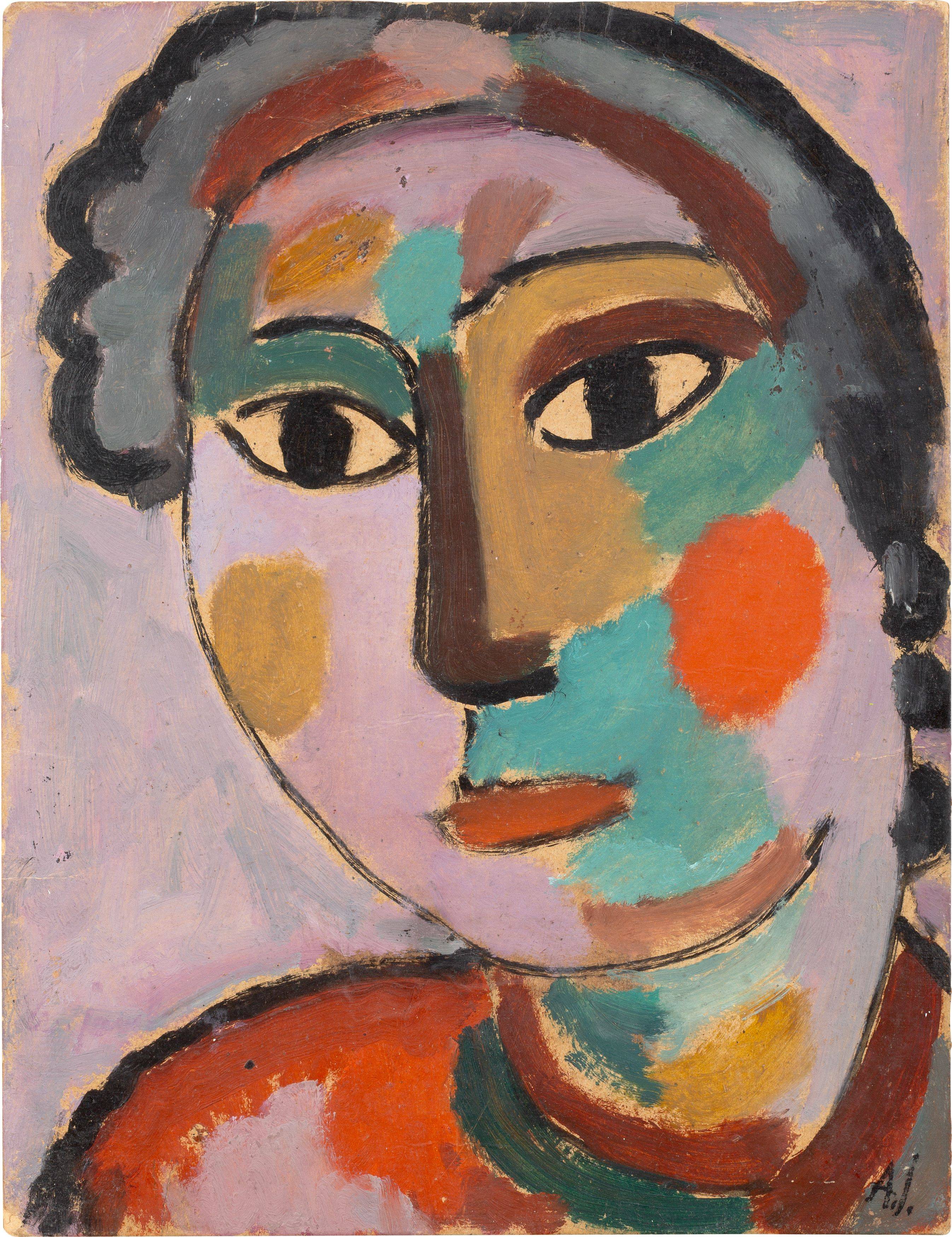
”Mädchenkopf”. Circa 1916

Background:

Background:


Background:
Estimate:
EUR 300,000
- 400,000
USD 337,000
- 449,000
Auction 378
Thursday, 26.11.2026, 6:00 PM
Request condition report
Ask our specialists
Galka Scheyer, Hollywood (?) / Private Collection, New York / Private Collection, Germany (acquired 1990 at Christie's, New York)
Auction: Anonymous Sale. New York, Parke-Bernet Galleries, 14.1.1959, cat. no. 78, ill. p. 52 / Auction: Impressionist and modern Paintings and Sculpture (Part II). New York, Christie's, 16.5.1990, cat. no. 387, ill.
Red, ochre, turquoise, black, dark green and old rose: the range of colours Alexej von Jawlensky chose for this "Mädchenkopf" (Head of a Girl) shows what really mattered to the painter here. He evidently wanted to sublimate the portrait of the girl (and his relationship to her), raising it to a spiritual plane, and he succeeded masterfully.
At the same time, the portrait is not entirely detached from reality. The large, alert eyes, the striking nose that suggests a classical profile, the finely drawn mouth: taken together, these are quite individual features. It seems natural to see in this "girl" someone who was close to Jawlensky, and there is one person who must come to mind first: Helene Nesnakomoff (1885–1965). She joined the household of Marianne von Werefkin and Jawlensky at about the age of ten, as an apprentice to Werefkin's lady's maid. Some six years later, the painter fathered a child with her, scandalously early: their son Andreas (1902–1984).
But either Alexej von Jawlensky painted her from memory, or she must be ruled out as the sitter, since around 1916 Helene was about thirty. In the end it does not matter who the girl was to whom the artist here erected a monument. In any case, Jawlensky considered the young girl worthy of sitting for him, and she spurred him on to a new artistic achievement.
The picture was painted at a time of great hardship for Werefkin and Jawlensky, for Nesnakomoff and Andreas. The outbreak of the First World War ended the good life the four had led in Munich-Schwabing. Material security, social recognition and a generally creative atmosphere: they had to give up all of this after being forced to leave Germany within 48 hours in August 1914 and fleeing to Switzerland. In Saint-Prex on Lake Geneva, conditions were cramped: the flat was tiny, and living together with Marianne von Werefkin, who until then had generously supported and encouraged Jawlensky, was strained and tense.
All the more astonishing, then, that Jawlensky was able to create a painting as enchanting as "Mädchenkopf". For all its spirituality, the character and radiance of this picture are thoroughly positive, optimistic, even almost cheerful. Jawlensky must have drawn this from within himself, and from the engaging personality of the unknown sitter. Ulrich Clewing
Subject to change - Please refer to our conditions of sale.